
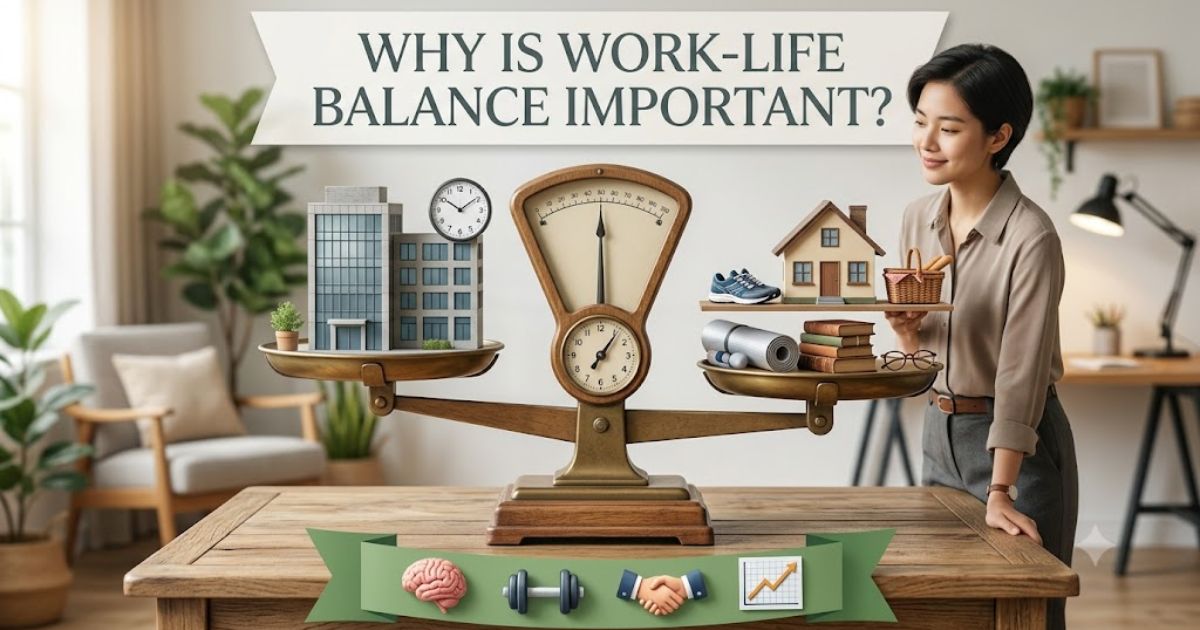

You’re answering emails at 10 PM. Again. Your kid asked you to play catch last weekend, and you promised “next time.” Your back hurts, you’re exhausted, and you can’t remember the last time you did something just because you wanted to. Sound familiar? Work life balance isn’t some corporate buzzword or luxury reserved for executives—it’s the difference between thriving and merely surviving. This matters because the cost of ignoring it shows up in your health, your relationships, your performance, and your happiness. Whether you’re grinding to provide for your family, chasing a promotion, or building something meaningful, understanding why balance matters is the first step toward actually achieving it. Here’s what really happens when work takes over, and more importantly, what you can do about it.
The Health Consequences Nobody Talks About
Working yourself into the ground doesn’t make you tough—it makes you sick.
Men who consistently work more than 55 hours per week face a 33% higher risk of stroke and a 13% increased risk of coronary heart disease compared to those working standard hours. That’s not motivation to work harder. That’s your body waving a red flag.
Physical symptoms of poor balance:
- Chronic fatigue that sleep doesn’t fix
- Persistent headaches and muscle tension
- Weight gain or loss without trying
- High blood pressure
- Weakened immune system
- Digestive problems
- Sleep disorders
The stress hormone cortisol becomes chronically elevated when you’re constantly in “work mode.” Over time, this damages nearly every system in your body. Your cardiovascular system takes a beating. Your metabolism gets thrown off. Even your ability to fight off a common cold diminishes.
Here’s the part that hits harder: these aren’t abstract future concerns. You feel them now. That tightness in your chest. The exhaustion that coffee can’t fix. The short fuse with people you care about.
Mental health impact:
- Increased anxiety and depression risk
- Burnout and emotional exhaustion
- Reduced cognitive function
- Difficulty concentrating
- Irritability and mood swings
- Loss of motivation
The American Psychological Association found that work is the second most cited source of significant stress. When work bleeds into every other area of life, that stress has nowhere to go. It just builds.
What Happens to Your Relationships
Your family doesn’t need the money as much as they need you.
That’s harsh, but it’s true. Obviously, providing for your family matters. But when providing becomes an excuse for absence, something breaks.
Missing dinner repeatedly sends a message. Missing your son’s games sends a message. Being physically present but mentally checked out, scrolling through work emails—that sends a message too. And kids receive these messages loud and clear: work is more important than them.
The relationship costs:
- Decreased quality time with spouse and children
- Higher divorce rates among chronically overworked individuals
- Reduced emotional intimacy
- Parenting regrets that can’t be undone
- Weakened friendships
- Social isolation
Marriages suffer particularly hard. Your partner becomes another person competing for your attention alongside your inbox. Resentment builds. Communication deteriorates. Date nights get cancelled. Conversations become transactional.
Friendships fade too. You cancel plans once, twice, three times. Eventually, people stop inviting you. You wake up one day and realize you haven’t had a meaningful conversation with a friend in months.
The brutal reality: time lost with family cannot be recovered. Your daughter will only be seven once. These moments don’t wait for you to figure out your priorities.
The Productivity Paradox
Here’s what the “grind culture” won’t tell you: working more doesn’t mean accomplishing more.
Research shows that productivity per hour declines sharply after 50 hours of work per week. After 55 hours, it drops so much that you might as well not have worked those extra hours at all.
Why longer hours backfire:
- Decision-making quality deteriorates
- Creativity and problem-solving suffer
- Error rates increase
- Recovery time between tasks lengthens
- Strategic thinking gets replaced by reactive firefighting
You’ve experienced this. That report that should take two hours takes four because you can’t focus. You make mistakes that create more work. You spend Tuesday fixing Monday’s errors made while exhausted.
The best workers aren’t the ones chained to their desks. They’re the ones who work intensely during work hours, then fully disconnect. They return refreshed, focused, and creative.
Performance benefits of balance:
| With Balance | Without Balance |
|---|---|
| Sharp focus during work hours | Constant distraction and brain fog |
| Higher quality output | More errors, revisions needed |
| Creative problem-solving | Reactive, survival mode thinking |
| Energy for challenging projects | Everything feels overwhelming |
| Clear priorities | Everything seems urgent |
Companies are catching on. The most forward-thinking organizations now recognize that rested employees outperform exhausted ones by massive margins.
The Career Impact You’re Not Seeing
Counterintuitively, sacrificing everything for work often damages your career.
Burnout leads to poor performance. Poor performance leads to stagnation. You become the guy who’s always busy but never seems to move forward.
Career benefits of maintaining balance:
- Better professional relationships
- Enhanced reputation as reliable and consistent
- Increased creativity and innovation
- Stronger leadership capabilities
- Reduced risk of catastrophic mistakes
- Longer career longevity
Leaders who maintain balance set better examples. They make sounder decisions. They build stronger teams. Meanwhile, the guy answering emails at midnight is often compensating for poor daytime productivity.
Burnout also destroys ambition. You stop caring about advancement. You stop learning. You enter survival mode, just trying to make it through each day. That’s not how careers advance.
The executives who last decades don’t do so by working themselves to death. They build sustainable practices, delegate effectively, and protect their recovery time.
Financial Security Beyond Your Paycheck
Your health is your most valuable asset. Literally.
Medical bills from stress-related illnesses can devastate family finances. Lost wages from sick days or reduced capacity cost more than you realize. Disability or early death creates financial catastrophes for families.
The financial equation of imbalance:
- Healthcare costs for stress-related conditions
- Reduced earning capacity due to burnout
- Career setbacks from poor performance
- Relationship costs (divorce is expensive)
- Shorter career span overall
Consider this: would you rather earn $100,000 a year for 30 healthy years, or $120,000 for 20 years before your body gives out? The math isn’t complicated.
Balance also affects decision-making. Exhausted people make poor financial choices. They overspend for convenience. They miss investment opportunities. They fail to negotiate effectively because they lack the energy.
Personal Identity and Purpose
You are not your job.
When work consumes your identity, who are you when you retire? When you get laid off? When you’re too sick to work?
Men particularly struggle with this. We’re socialized to define ourselves by our work. “What do you do?” is often the second question someone asks after learning your name.
What you lose when work is everything:
- Hobbies and personal interests
- Sense of joy unrelated to productivity
- Personal growth in non-work areas
- Spiritual or philosophical development
- Community connections
- Sense of play and recreation
The richest life includes multiple sources of meaning. Family. Friendships. Community involvement. Physical pursuits. Creative outlets. Learning for its own sake.
When you’re 75 and looking back, you won’t reminisce about that quarterly report. You’ll remember coaching your kid’s soccer team. The fishing trip with your dad. The garage project you finally completed. The volunteer work. The quiet Sunday mornings.
Setting Boundaries That Actually Work
Knowing why balance matters is worthless without knowing how to achieve it. Here’s what actually works.
Establish clear work hours:
- Define when you start and stop
- Communicate these boundaries to colleagues
- Physically leave work (or your home office) when done
- Create a shutdown ritual to signal the end of the workday
Your availability shouldn’t be unlimited. Even if you’re salary, you’re trading defined value for defined compensation. Giving free hours doesn’t make you dedicated—it makes you exploited.
Protect your mornings or evenings:
Choose one. Either your mornings belong to family, exercise, or personal projects, or your evenings do. Non-negotiable.
Many successful people protect 6-9 AM for exercise, family breakfast, and personal development. Others draw the line at 6 PM. Find what works, then defend it fiercely.
Use technology intentionally:
- Turn off work notifications after hours
- Delete work email from your phone (if possible)
- Use separate devices for work and personal life
- Set auto-responses for evenings and weekends
Your phone shouldn’t be an electronic leash. Every ping doesn’t require immediate attention.
Learn to say no:
This might be the hardest skill. “No, I can’t take that meeting at 7 PM.” “No, I can’t work this weekend.” “No, that’s not my responsibility.”
Saying yes to everything means saying no to your health, family, and sanity.
Delegate and ask for help:
Superheroes don’t exist. If your workplace requires superhuman effort to function normally, that’s a systemic problem, not your personal failure.
Ask for support. Delegate tasks. Share workload. Request additional resources. If the answer is always no, you might need a different workplace.
Common Mistakes That Keep Men Out of Balance
Smart people make these mistakes constantly.
Mistake #1: Waiting for permission
Your boss won’t give you permission to have balance. Your company won’t spontaneously decide you’re working too hard. You must claim it yourself.
Mistake #2: Believing you’re indispensable
You’re not. If you got hit by a bus tomorrow, your company would replace you within weeks. This isn’t cynical—it’s reality. Operate accordingly.
Mistake #3: Confusing busy with productive
Activity isn’t achievement. Filling your calendar doesn’t mean you’re accomplishing meaningful work.
Mistake #4: Thinking balance means 50/50 every day
Balance doesn’t mean perfect equilibrium daily. Some weeks are heavy. Balance is measured over months, not days.
Mistake #5: Ignoring the warning signs
Your body tells you when something’s wrong. Listen before it forces you to listen.
Mistake #6: Sacrificing family for a company that won’t sacrifice for you
Layoffs happen. Companies restructure. Jobs disappear. Your family is permanent. Treat them accordingly.
Practical Steps to Start Today
You don’t need a complete life overhaul. Start small.
Week 1: Audit your time
Track where your hours actually go for one week. Work, sleep, family, commute, recreation, everything. You can’t fix what you don’t measure.
Week 2: Identify one boundary
Pick the easiest boundary to establish. Maybe no email after 8 PM. Maybe leaving work by 6 PM twice a week. Start there.
Week 3: Communicate your boundaries
Tell your manager, colleagues, and family what you’re doing and why. Most resistance comes from unclear expectations.
Week 4: Schedule personal time like meetings
Put family dinners on your calendar. Block exercise time. Schedule date night. If it’s not on the calendar, it won’t happen.
Ongoing: Review and adjust monthly
What’s working? What isn’t? Balance is dynamic, not static. Adjust as needed.
When Work Demands Are Legitimately High
Sometimes work genuinely requires intense periods.
Project launches. Busy seasons. Emergencies. These happen. The question is whether they’re the exception or the rule.
Managing intense work periods:
- Set clear end dates (“This deadline is Friday, then I’m taking Monday off”)
- Communicate impact to family in advance
- Schedule recovery time immediately after
- Don’t make intense periods the new normal
- Evaluate whether the situation is sustainable
If every period is intense, you’re not managing crisis—you’re living in dysfunction. That’s a workplace problem requiring a workplace solution (or a new workplace).
Signs You Need to Make Changes Now
Your body and life give clear signals.
Physical red flags:
- Frequent illness
- Unexplained pain
- Sleep problems
- Weight changes
- Chronic exhaustion
Emotional red flags:
- Constant irritability
- Feeling numb or detached
- Dreading Monday on Friday afternoon
- No joy in things you used to enjoy
- Thinking about work constantly
Relationship red flags:
- Family complains about your absence
- You’ve missed multiple important events
- Communication with spouse is mostly logistics
- Kids seem distant or withdrawn
- Friends have stopped reaching out
Performance red flags:
- Making unusual mistakes
- Can’t focus or complete tasks
- Everything feels overwhelming
- Taking longer to do basic work
- Zero motivation or engagement
If several of these apply, something needs to change. Not eventually. Now.
What Good Balance Actually Looks Like
Balance doesn’t mean perfection. It means sustainable.
You work hard during work hours. You’re present during family time. You maintain your health. You pursue interests beyond work. You have energy for relationships. You sleep adequately. You feel generally satisfied with how you spend your time.
Some days tilt toward work. Others tilt toward family. Overall, you’re not chronically sacrificing one area for another.
You can perform well at work without sacrificing your health. You can provide for your family without being absent. You can be ambitious without being exhausted.
This isn’t revolutionary. It’s just sustainable.
Expert Recommendations
Mental health professionals, cardiologists, marriage counselors, and productivity experts all say the same thing: balance isn’t optional for long-term wellbeing.
Key professional insights:
- Schedule regular health checkups to catch stress-related issues early
- Consider therapy or counseling for stress management strategies
- Involve your family in boundary-setting conversations
- Find at least one non-work activity that brings genuine joy
- Build a support network of people facing similar challenges
- Evaluate your job fit honestly—some positions are incompatible with health
If you’re religious or spiritual, reconnecting with those practices often helps. Many men find physical activities (sports, hiking, lifting) essential for mental reset. Others need creative outlets.
The specifics matter less than having something outside work that feeds your soul.
Frequently Asked Questions
What if my industry just doesn’t allow work life balance?
Some industries have cultures of overwork. That doesn’t make it healthy or necessary. People in every industry have found ways to establish boundaries. Sometimes it means choosing different companies within your industry. Other times it means being the one who sets a new standard. If the industry truly won’t allow basic human boundaries, you need to decide what you’re willing to sacrifice permanently.
How do I tell my boss I need better boundaries?
Frame it around performance and sustainability. “I’ve noticed my productivity and quality improve when I maintain clear boundaries. I’d like to discuss how we can structure my work to maximize my effectiveness while maintaining sustainable practices.” Most reasonable managers prefer productive employees to burned-out ones.
Won’t focusing on balance hurt my career advancement?
Quality work advances careers, not hours logged. If your workplace only promotes based on face time rather than results, that’s valuable information about whether you want to advance there. Many high-performers maintain balance by working smarter, delegating effectively, and producing exceptional results during focused work time.
What if I’m the primary breadwinner and can’t risk my job?
Setting boundaries doesn’t mean refusing to work. It means working sustainably. You’re actually risking your family’s financial security more by burning out, getting sick, or making catastrophic mistakes from exhaustion. Sustainable work protects your earning capacity long-term.
How much time should I spend with family versus work?
There’s no magic number. The question is whether your family feels prioritized and whether you’re present during family time. Quality matters more than raw hours. Thirty minutes of genuinely engaged time with your kids beats three distracted hours on your phone.
Is it selfish to prioritize personal time and hobbies?
Taking care of yourself enables you to take care of others. You can’t pour from an empty cup. Personal time that restores your energy, health, and mental wellbeing makes you a better employee, partner, and father. That’s not selfish—that’s sustainable.
What if my financial obligations require long hours?
Examine this carefully. Sometimes we assume we need more than we do. Other times, we’re in genuinely tight situations. If long hours are truly necessary, set a specific goal and timeline. “I’ll work 55-hour weeks for the next six months to pay off this debt, then reduce to 45.” Without clear goals and timelines, temporary sacrifices become permanent lifestyle.
How do I stop feeling guilty when I’m not working?
Recognize that guilt is often programming, not reality. You were taught that your value comes from productivity. Challenge that belief. Your worth as a human isn’t determined by your output. Practice being present during non-work time. The guilt typically fades as you experience the benefits of balance.
Conclusion
Work life balance matters because you matter. Your health matters. Your relationships matter. Your happiness matters.
The myth that you have to choose between career success and personal wellbeing is just that—a myth. The most successful, sustainable careers are built on foundations of health, strong relationships, and clear boundaries.
You won’t look back on your life wishing you’d spent more time at the office. You’ll look back on moments with people you love, experiences that challenged you, contributions that mattered, and the life you built outside the office.
Start small. Pick one boundary. Protect one evening. Take one actual lunch break. These small changes compound into transformed lives.
Your family needs you present, not just providing. Your health needs protection, not exploitation. Your career needs sustainable practices, not sprint-until-you-collapse intensity.
The question isn’t whether you can afford to prioritize balance. It’s whether you can afford not to.