
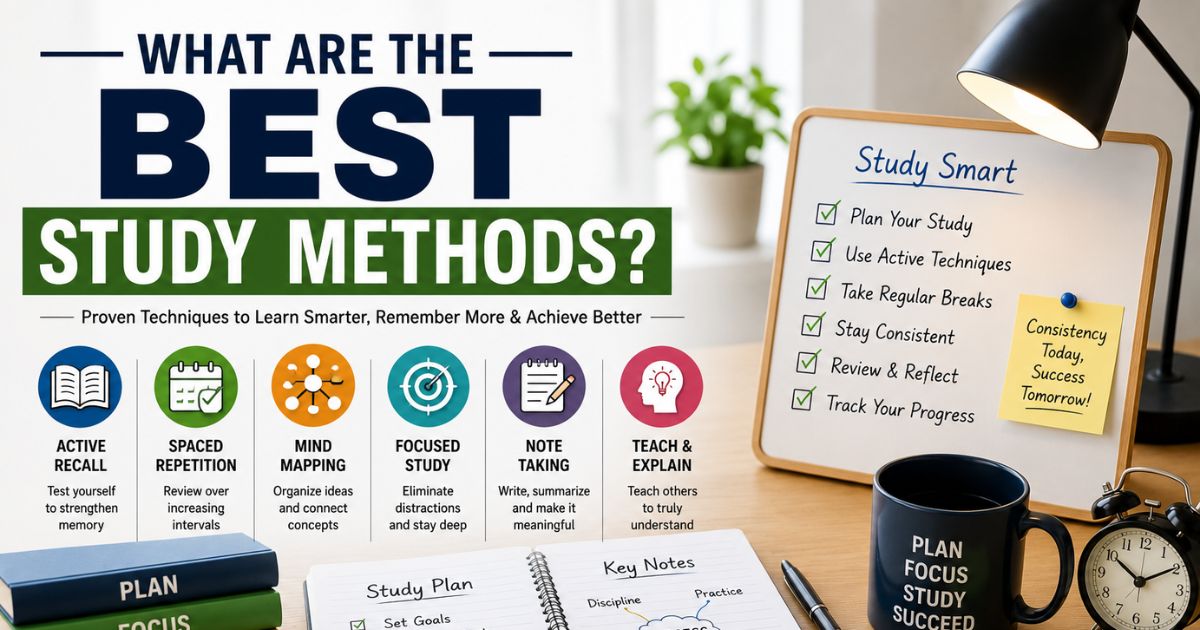

Studying harder doesn’t always mean studying smarter. Every student has sat through hours of rereading notes or highlighting textbooks, only to blank during the exam. The problem isn’t effort—it’s method. Cognitive science has identified specific techniques that dramatically improve how we encode, store, and retrieve information. Whether you’re preparing for finals, learning a new language, or mastering complex concepts, the right study methods can cut your study time in half while doubling your results. This guide breaks down the most effective, research-backed techniques and shows you exactly how to apply them to your coursework.
Active Recall: The Foundation of Effective Learning
Active recall forces your brain to retrieve information from memory rather than passively reviewing it. This retrieval process strengthens neural pathways and creates lasting memories.
Instead of rereading your history notes five times, close the book and write down everything you remember about the French Revolution. The struggle to remember—even when you can’t recall everything perfectly—is what builds long-term retention.
How to practice active recall:
- Close your textbook and write summary paragraphs from memory
- Create questions from your notes, then answer them without looking
- Use blank paper to recreate diagrams, formulas, or processes
- Teach the material to someone else without referencing your materials
- Build flashcards that ask questions, not just definitions
The discomfort you feel when struggling to remember is actually a sign the method is working. Your brain is being challenged to form stronger connections.
Common mistakes to avoid:
Checking answers too quickly defeats the purpose. Spend at least 30 seconds attempting to recall before looking at the answer. The effort matters more than immediate accuracy.
Spaced Repetition: Timing Your Reviews for Maximum Impact
Your brain forgets information predictably. Spaced repetition exploits this forgetting curve by scheduling reviews at optimal intervals—right before you’re about to forget.
Reviewing material once immediately, again after one day, then after three days, then a week, then two weeks creates exponentially stronger memories than cramming for hours the night before.
Effective spacing schedule:
- First review: Same day, 4-6 hours after initial learning
- Second review: 24 hours later
- Third review: 3 days later
- Fourth review: 7 days later
- Fifth review: 14 days later
- Sixth review: 30 days later
Digital tools like Anki automate this process, but a simple calendar reminder system works equally well.
Why spacing works:
Each time you successfully recall information that’s starting to fade, you’re telling your brain “this is important—store it permanently.” Material reviewed too early doesn’t strengthen memory. Material reviewed too late requires relearning from scratch.
The Feynman Technique: Simplify to Understand
Named after physicist Richard Feynman, this method exposes gaps in your understanding by forcing you to explain concepts in simple language.
Four-step process:
- Choose a concept you need to learn and write the name at the top of a blank page
- Explain it in simple terms as if teaching a child—no jargon, no complex vocabulary
- Identify gaps where your explanation breaks down or requires technical terms
- Review source material to fill those gaps, then simplify your explanation again
If you can’t explain how photosynthesis works using only words a ten-year-old knows, you don’t truly understand photosynthesis.
This technique works brilliantly for:
- Scientific concepts and processes
- Mathematical theories
- Historical events and their causes
- Complex systems and how they interact
The breakthrough happens when you realize which parts you’ve memorized versus which parts you actually understand.
Interleaving: Mix It Up for Deeper Learning
Interleaving means studying multiple related topics in one session rather than blocking (studying one topic completely before moving to the next).
Instead of doing 30 algebra problems, then 30 geometry problems, mix them together: algebra, geometry, algebra, trigonometry, geometry, algebra.
Why interleaving beats blocking:
Your brain learns to distinguish between problem types and select the appropriate strategy. Blocked practice makes everything feel easy in the moment because you’re repeating the same pattern, but you struggle when different concepts appear mixed on the actual test.
How to implement interleaving:
- Shuffle practice problems from different chapters
- Study related subjects back-to-back (biology then chemistry, not biology then history)
- Review older material while learning new concepts
- Practice identifying which technique applies to which problem
The confusion you initially feel is productive difficulty—it’s forcing your brain to work harder and learn more deeply.
Elaborative Interrogation: Ask “Why” and “How”
This method involves constantly questioning the material you’re learning by asking how and why things work.
Don’t just memorize that mitochondria are the powerhouse of the cell. Ask: Why do cells need a powerhouse? How do mitochondria produce energy? What would happen without them? How does this connect to cellular respiration?
Questions to ask while studying:
- Why does this concept matter?
- How does this connect to what I already know?
- What would happen if this variable changed?
- How is this different from similar concepts?
- What causes this outcome?
- What examples demonstrate this principle?
These questions force you to build connections between new information and existing knowledge, creating a web of understanding rather than isolated facts.
Self-Explanation: Narrate Your Problem-Solving
Talk yourself through each step of solving a problem, explaining your reasoning out loud or in writing.
When solving a physics problem, don’t just calculate—explain: “I’m using the kinematic equation here because I have initial velocity, acceleration, and need to find distance. Time isn’t given, so I need to eliminate it by…”
Benefits of self-explanation:
- Catches logical errors in real-time
- Clarifies your thought process
- Makes implicit knowledge explicit
- Creates verbal cues you can recall during exams
This works exceptionally well for mathematics, programming, scientific reasoning, and essay writing.
Dual Coding: Combine Words and Visuals
Your brain processes visual and verbal information through different channels. Using both simultaneously doubles your encoding power.
Create mind maps that combine key terms with symbols, arrows, and spatial relationships. Draw diagrams while writing explanations. Turn processes into flowcharts with annotations.
Effective dual coding strategies:
- Sketch diagrams while reading textbook explanations
- Create timeline graphics with detailed annotations
- Build concept maps connecting related ideas visually
- Use color coding to categorize information
- Draw before-and-after illustrations for processes
A timeline of World War II with color-coded alliances, battle icons, and annotation boxes creates multiple memory pathways that pure text cannot match.
Retrieval Practice Through Testing
Testing yourself is not just assessment—it’s one of the most powerful learning tools available.
Practice tests improve retention more effectively than additional studying. The act of retrieving information under test-like conditions strengthens memory and identifies weak spots.
How to maximize retrieval practice:
- Take practice tests in realistic conditions (timed, closed-book)
- Create your own tests from scratch
- Exchange practice questions with classmates
- Use past exams from your instructor
- Quiz yourself before you feel ready
Timing matters:
Test yourself when material still feels somewhat unfamiliar. Testing after you’ve mastered material is less effective. The struggle during retrieval is what builds long-term memory.
The SQ3R Method: A Framework for Reading Comprehension
SQ3R (Survey, Question, Read, Recite, Review) provides structure for tackling dense textbooks and academic articles.
Five-step process:
- Survey: Scan headings, subheadings, graphics, and summaries to build a mental framework
- Question: Convert headings into questions you expect the section to answer
- Read: Read actively with your questions in mind
- Recite: Close the book and summarize what you learned in your own words
- Review: Return to your questions and verify you can answer them
This transforms passive reading into an active engagement that drastically improves comprehension and retention.
The Pomodoro Technique: Optimize Your Study Sessions
Your brain’s focus deteriorates after 25-45 minutes of concentrated work. The Pomodoro Technique structures studying into focused intervals with built-in breaks.
Standard Pomodoro schedule:
- 25 minutes of focused study
- 5-minute break
- Repeat four times
- Take a 15-30 minute longer break
Why timed intervals work:
Knowing a break is coming reduces the urge to check your phone. Short breaks prevent mental fatigue. Regular intervals maintain high-quality focus throughout your session.
During breaks:
- Stand and stretch
- Walk around
- Get water or a snack
- Avoid screens when possible
- Don’t start new cognitive tasks
The break is recovery time. Scrolling social media doesn’t let your brain rest.
Concrete Examples: Anchor Abstract Concepts
Abstract concepts become memorable when connected to specific, concrete examples.
Learning about supply and demand? Don’t just memorize the curves. Think about concert tickets for a popular artist (limited supply, high demand, prices skyrocket) versus generic office supplies (abundant supply, steady demand, low prices).
Creating effective examples:
- Use situations from your own life
- Choose vivid, memorable scenarios
- Connect to current events or pop culture
- Make examples emotionally engaging
- Use multiple examples for complex concepts
The human brain evolved to remember stories and concrete details, not abstract principles. Examples provide the hooks that make concepts stick.
Distributed Practice: Spread Out Your Study Time
Five one-hour study sessions spread across a week beat one five-hour marathon session every time.
Distributed practice takes advantage of how memory consolidation works. Your brain needs time between sessions to process, organize, and store information.
Optimal distribution:
- Study for 30-90 minutes per session
- Schedule sessions across multiple days
- Study the same subject 3-4 times per week rather than once
- Avoid marathon sessions longer than 2-3 hours
The spacing effect:
Each time you return to material after a gap, you’re practicing retrieval. Material spaced over ten days creates stronger memories than the same amount of time compressed into two days.
Common Study Mistakes That Sabotage Your Results
Rereading and highlighting:
These create the illusion of learning. The material feels familiar, so you assume you know it. But familiarity isn’t the same as retrieval ability. Highlighting is passive; it doesn’t engage your brain.
Studying in the same place every time:
Some context variation helps. Your brain encodes environmental cues along with information. Varying study locations slightly reduces context-dependent memory (where you can only recall information in the place you learned it).
Multitasking:
Every time you switch tasks, your brain needs time to refocus. Checking notifications while studying can double or triple the time needed to learn material. True focus requires single-tasking.
Studying when exhausted:
Sleep-deprived studying is dramatically less efficient. Your brain consolidates memories during sleep, so pulling all-nighters undermines the entire point of studying.
Not taking notes by hand:
Typing lets you transcribe lectures verbatim without processing. Handwriting is slower, forcing you to summarize and paraphrase—which requires understanding.
Building Your Personal Study System
No single method works for everyone or every subject. The most effective approach combines multiple techniques tailored to your material and learning preferences.
For memorization-heavy subjects (vocabulary, anatomy, dates):
- Active recall through flashcards
- Spaced repetition scheduling
- Dual coding with images
- Concrete examples
For concept-based subjects (physics, philosophy, economics):
- Feynman Technique
- Elaborative interrogation
- Self-explanation
- Practice problems with interleaving
For skill-based subjects (math, programming, writing):
- Retrieval practice through problems
- Interleaving different problem types
- Self-explanation of your process
- Distributed practice sessions
For reading-heavy subjects (history, literature, social sciences):
- SQ3R method
- Active recall through summary writing
- Elaborative interrogation
- Mind mapping connections
Sample weekly schedule:
| Day | Activity | Method |
|---|---|---|
| Monday | Learn new material | SQ3R, take hand-written notes |
| Tuesday | First review | Active recall, self-testing |
| Wednesday | Different topic | Apply same methods |
| Thursday | Mixed review | Interleaving both topics |
| Saturday | Second review | Practice tests, spaced repetition |
| Next Monday | Third review | Active recall, identify weak areas |
Expert Tips for Different Learning Scenarios
Preparing for essay exams:
Practice writing timed essays without notes. Outline responses to potential questions. Don’t just memorize content—practice the writing process under time pressure.
Preparing for multiple-choice exams:
Create your own multiple-choice questions with plausible wrong answers. This forces you to understand subtle distinctions between concepts.
Learning procedural skills:
Space out practice sessions. Don’t perfect one skill before moving to the next—interleave related skills to improve discrimination and application.
Retaining information long-term:
The final review should happen 30+ days after initial learning. Information successfully retrieved after a month becomes nearly permanent.
Group study sessions:
Structure them around testing each other, not rereading together. Explain concepts to each other. Debate different approaches to problems.
Frequently Asked Questions
How long should I study each day?
Quality matters more than quantity. Three focused 45-minute sessions with active methods beat six hours of passive rereading. Most students benefit from 2-4 hours of high-quality studying daily, distributed across multiple sessions.
Is it better to study at night or in the morning?
Study difficult material when your brain is freshest—morning for most people. Review and practice can happen during lower-energy periods. Schedule matches circadian rhythms beats forcing yourself to work when your brain is foggy.
How many times should I review material before an exam?
At minimum: once the same day you learn it, again the next day, again 3-4 days later, and a final review 1-2 days before the exam. More complex material benefits from additional reviews.
Can I listen to music while studying?
Instrumental music or ambient noise may help some people focus, but music with lyrics competes for your brain’s language processing. Silence or white noise is optimal for maximum retention.
What should I do the night before a big exam?
Light review of summaries and practice problems. Get 7-9 hours of sleep. Sleep is when memory consolidation happens—pulling an all-nighter undermines weeks of preparation.
How do I stay motivated when studying feels boring?
Use active methods that engage your brain. Passive studying is boring because your brain isn’t challenged. Testing yourself, explaining concepts out loud, and creating your own examples are inherently more engaging.
Should I study one subject until I master it or rotate between subjects?
Rotation (interleaving) is generally more effective. Your brain learns to distinguish concepts and maintains fresher focus. Spend 45-90 minutes on one subject, then switch.
How can I remember everything I study?
You won’t remember everything, and that’s normal. Focus on understanding core concepts and their connections. Details become easier to recall when you understand the framework. Spaced repetition handles long-term retention.
Key Takeaways
The best study methods share common principles: they’re active, not passive; they’re spaced over time, not crammed; they force retrieval, not just recognition; and they build understanding, not just familiarity.
Start with these three high-impact changes:
- Replace rereading with active recall—close the book and write what you remember
- Space your studying across multiple days instead of marathon sessions
- Test yourself frequently, especially when material still feels challenging
Experiment with different combinations for different subjects. What works for memorizing anatomy terms won’t work identically for solving calculus problems. Pay attention to which methods feel productively difficult versus merely frustrating.
The techniques that feel hardest—struggling to recall, explaining out loud, testing before you’re ready—are precisely the ones that build lasting learning. Embrace the struggle. That’s where real learning happens.
Conclusion
Effective studying isn’t about spending more hours with your textbooks—it’s about using methods that align with how your brain actually learns. Active recall, spaced repetition, and retrieval practice have been proven through decades of cognitive science research to dramatically outperform traditional techniques like rereading and highlighting.
Start small. Choose two or three methods from this guide and implement them this week. Track what works for your specific subjects and learning style. Build systems that make these techniques habitual rather than relying on motivation alone.
Your grades reflect not just what you know, but how effectively you can retrieve and apply that knowledge under pressure. The right study methods transform both. The studying techniques you choose today shape not just your next exam score, but your capacity to learn anything throughout your life.