
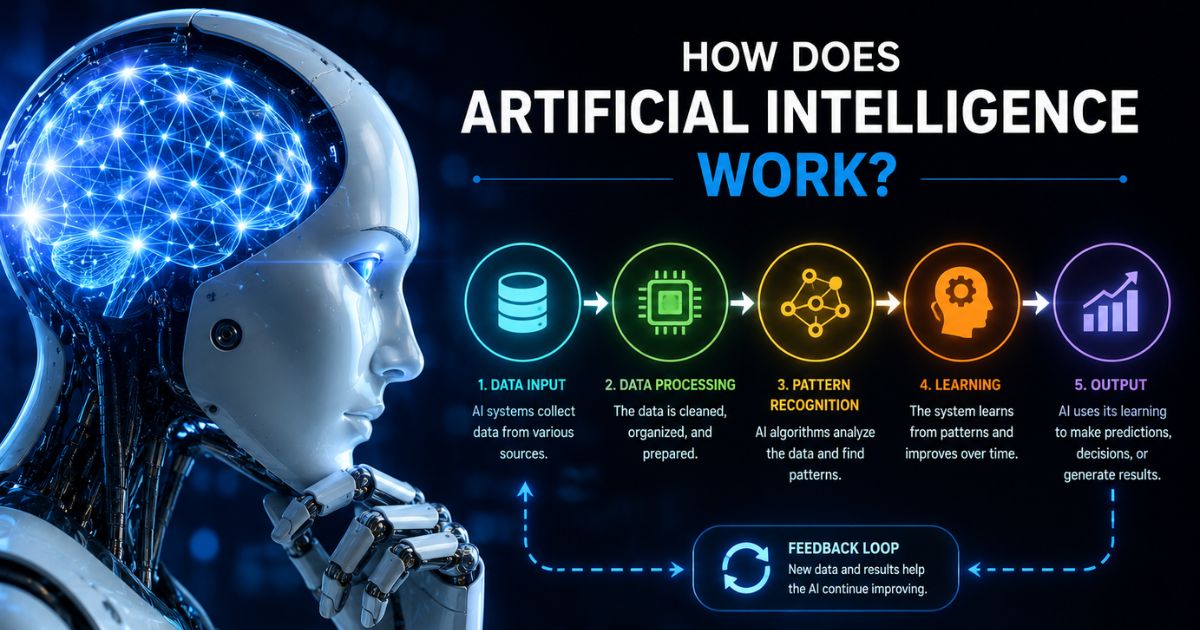

Artificial intelligence has transformed from science fiction into everyday reality. You interact with AI when you ask Siri a question, get Netflix recommendations, or unlock your phone with your face. But what’s actually happening behind the scenes? How do machines “think,” recognize patterns, and make decisions without explicit programming for every scenario? This guide breaks down the mechanics of AI systems in clear terms—explaining neural networks, machine learning processes, training methods, and the real technology powering intelligent machines. Whether you’re using AI tools or simply curious about the technology reshaping our world, you’ll understand exactly how these systems function.
What Is Artificial Intelligence?
Artificial intelligence refers to computer systems that perform tasks typically requiring human intelligence. These tasks include recognizing speech, identifying objects in images, translating languages, making predictions, and solving complex problems.
Unlike traditional software that follows rigid, pre-programmed rules, AI systems learn from data. They identify patterns, adjust their behavior based on experience, and improve performance over time without being explicitly programmed for every possible situation.
Three key characteristics define AI systems:
- Learning capability: They improve through exposure to data
- Pattern recognition: They detect relationships humans might miss
- Autonomous decision-making: They make choices based on learned information
AI exists on a spectrum. Narrow AI (also called weak AI) excels at specific tasks—like spam filtering or chess—but can’t transfer that knowledge elsewhere. General AI, which would match human-level intelligence across all domains, remains theoretical.
The Foundation: How Machines Learn
Machine learning forms the backbone of modern AI. Instead of programmers writing rules for every scenario, they create systems that generate their own rules by analyzing data.
The process works like this:
1. Data Collection
The system receives massive amounts of example data. For image recognition, this might be millions of labeled photos. For language processing, billions of text samples.
2. Pattern Detection
The algorithm searches for statistical patterns and relationships within the data. It notices which features consistently appear together or predict certain outcomes.
3. Model Creation
The system builds a mathematical model representing those patterns. This model becomes the decision-making framework.
4. Testing and Refinement
The model makes predictions on new data it hasn’t seen before. Incorrect predictions trigger adjustments to improve accuracy.
5. Deployment
Once performance meets standards, the model handles real-world tasks.
Think of teaching a child to recognize dogs. You don’t explain every possible dog feature. Instead, you show examples—large dogs, small dogs, fluffy dogs, short-haired dogs. Eventually, the child recognizes dogs they’ve never seen before by generalizing from those examples. Machine learning works similarly, but with mathematical precision and massive scale.
Types of Machine Learning
AI systems learn through three primary approaches, each suited to different problems.
Supervised Learning
The system learns from labeled examples where the correct answer is provided.
How it works:
- Input data comes with correct outputs (labels)
- The algorithm learns to map inputs to outputs
- It then predicts labels for new, unseen data
Common applications:
- Email spam detection (emails labeled spam/not spam)
- Medical diagnosis (symptoms paired with diagnoses)
- Price prediction (historical data with actual prices)
- Image classification (photos labeled with objects they contain)
Supervised learning requires substantial human effort to create labeled datasets, but it produces highly accurate results for well-defined tasks.
Unsupervised Learning
The system finds patterns in unlabeled data without being told what to look for.
How it works:
- Receives data without predefined categories or labels
- Discovers hidden structures and groupings
- Identifies similarities and anomalies independently
Common applications:
- Customer segmentation (grouping shoppers by behavior)
- Anomaly detection (identifying unusual transactions)
- Recommendation systems (finding similar products or content)
- Data compression (identifying core features)
This approach excels when you don’t know what patterns exist or when labeling data is impractical.
Reinforcement Learning
The system learns through trial and error, receiving rewards for beneficial actions and penalties for harmful ones.
How it works:
- Takes actions in an environment
- Receives feedback in the form of rewards or penalties
- Adjusts strategy to maximize long-term rewards
- Explores different approaches while exploiting what works
Common applications:
- Game playing (AlphaGo, chess engines)
- Robotics (teaching machines to walk or manipulate objects)
- Autonomous vehicles (learning safe driving behaviors)
- Resource optimization (managing power grids or data centers)
This mirrors how humans learn many skills—through practice, feedback, and gradual improvement.
Neural Networks: The Brain-Inspired Engine
Neural networks power most breakthrough AI applications. While inspired by biological brains, they’re mathematical systems rather than biological replicas.
Basic Structure
A neural network consists of interconnected layers of nodes (artificial neurons):
Input Layer
Receives raw data—pixel values for images, word representations for text, sensor readings for robotics.
Hidden Layers
Process information through mathematical transformations. Each node receives signals from the previous layer, performs calculations, and passes results forward. Deep learning refers to networks with many hidden layers.
Output Layer
Produces the final result—a classification, prediction, or decision.
How Information Flows
When you feed data into a neural network:
- Each connection between nodes has a weight (importance value)
- Each node multiplies incoming signals by these weights
- The node sums these weighted inputs
- An activation function determines whether the node “fires” (passes signal forward)
- This process repeats through each layer until reaching the output
Initially, weights are random, producing terrible results. Training adjusts these weights so the network produces correct outputs.
The Training Process
Training uses a method called backpropagation:
- The network makes a prediction
- An error function measures how wrong the prediction is
- The algorithm calculates how each weight contributed to the error
- Weights adjust slightly to reduce the error
- This repeats millions of times across the training dataset
Gradually, the network learns which patterns in the input data correspond to which outputs. Early layers typically detect simple features (edges in images, common letter combinations in text). Deeper layers combine these into complex concepts (faces, sentence meanings).
Why Neural Networks Work
They excel at finding non-linear relationships—complex patterns that simpler algorithms miss. With sufficient data and computational power, they can approximate incredibly complex functions, making them suitable for problems that resist traditional programming approaches.
Deep Learning: Multiple Layers of Understanding
Deep learning uses neural networks with many layers (sometimes hundreds) to learn hierarchical representations of data.
Convolutional Neural Networks (CNNs)
Specialized for processing grid-like data, particularly images.
Architecture:
- Convolutional layers detect local patterns (edges, textures, shapes)
- Pooling layers reduce dimensions while preserving important features
- Fully connected layers combine features to make final classifications
How they work:
CNNs apply filters across an image, detecting specific patterns regardless of position. Early layers recognize edges at various angles. Middle layers combine edges into shapes and textures. Deep layers recognize complete objects (eyes, wheels, doors).
This hierarchical approach mirrors how human visual systems process information, building complex understanding from simple components.
Applications:
- Facial recognition
- Medical image analysis
- Autonomous vehicle vision
- Quality control inspection
- Satellite image interpretation
Recurrent Neural Networks (RNNs)
Designed for sequential data where order matters.
Architecture:
Unlike standard neural networks that treat inputs independently, RNNs maintain internal memory. Information from previous inputs influences how the network processes current inputs.
How they work:
At each step, the network receives both new input and its previous state. This allows it to track context and dependencies across sequences.
Applications:
- Language translation
- Speech recognition
- Text generation
- Time series prediction
- Music composition
Advanced variants:
Long Short-Term Memory (LSTM) and Gated Recurrent Units (GRU) networks solve problems with basic RNNs, particularly maintaining context over long sequences.
Transformers
The architecture revolutionizing natural language processing.
Key innovation:
Attention mechanisms allow the model to focus on relevant parts of input when processing each element. Rather than processing sequences step-by-step, transformers analyze entire inputs simultaneously, identifying relationships between any elements regardless of distance.
How attention works:
When processing a word in a sentence, the attention mechanism determines which other words provide important context. In “The animal didn’t cross the street because it was too tired,” attention helps the model understand “it” refers to “animal” rather than “street.”
Applications:
- Large language models (GPT, BERT)
- Advanced translation systems
- Text summarization
- Question answering
- Code generation
Transformers scale remarkably well, with performance improving as model size and training data increase—the principle behind ChatGPT and similar systems.
Natural Language Processing: Understanding Human Language
NLP enables machines to comprehend, generate, and manipulate human language.
Text Representation
Computers can’t directly understand words. Systems convert language into numerical representations:
Word Embeddings
Each word becomes a vector (list of numbers) in high-dimensional space. Similar words have similar vectors. The vector for “king” minus “man” plus “woman” yields a vector close to “queen”—the math captures meaning relationships.
Contextual Embeddings
Modern systems like BERT create different representations for the same word based on context. “Bank” has different meanings in “river bank” versus “bank account,” and these models capture that distinction.
Language Understanding Tasks
Tokenization
Breaking text into meaningful units (words, subwords, or characters) that the model processes.
Part-of-Speech Tagging
Identifying whether each word functions as a noun, verb, adjective, etc.
Named Entity Recognition
Detecting and classifying names of people, organizations, locations, dates, and other specific entities.
Sentiment Analysis
Determining whether text expresses positive, negative, or neutral attitudes.
Dependency Parsing
Understanding grammatical relationships between words—which words modify which, what’s the subject, what’s the object.
Language Generation
Modern AI generates remarkably human-like text through:
Next-Token Prediction
The model calculates probability distributions for what word should come next given previous context. GPT-style models repeat this process, generating one word at a time.
Fine-Tuning
Pre-trained language models learn general language patterns from massive text corpora. Fine-tuning adapts them to specific tasks (answering questions, writing code, following instructions) using smaller, specialized datasets.
Prompt Engineering
The way you phrase inputs dramatically affects outputs. Well-designed prompts leverage the model’s capabilities more effectively.
Computer Vision: Seeing the World
Computer vision enables machines to extract meaning from visual data.
Image Classification
The system assigns labels to entire images.
Process:
- Image converts to numerical arrays (pixel values)
- CNN layers detect progressively complex features
- Final layers produce probability scores for each possible category
- Highest-scoring category becomes the prediction
Training requires thousands or millions of labeled images. ImageNet, containing millions of labeled images across thousands of categories, enabled breakthrough advances in computer vision.
Object Detection
Locating and classifying multiple objects within a single image.
Advanced techniques:
- Region-based CNNs identify candidate regions, then classify each
- YOLO (You Only Look Once) processes the entire image in one pass for real-time detection
- Models output bounding boxes (coordinates) and classification labels for each detected object
Applications:
- Autonomous vehicles identifying pedestrians, vehicles, signs, and obstacles
- Retail systems tracking inventory
- Security systems detecting suspicious activities
- Medical imaging identifying tumors or abnormalities
Image Segmentation
Classifying every pixel in an image, essentially outlining object boundaries precisely.
Types:
- Semantic segmentation labels each pixel by category (all pixels belonging to “road,” “sky,” “building”)
- Instance segmentation distinguishes between individual objects within the same category (separating each car rather than labeling all as “car”)
This pixel-level understanding enables applications requiring precise boundaries, like medical imaging analysis or augmented reality.
Facial Recognition
Identifying or verifying individuals from facial features.
Process:
- Face detection locates faces in images
- Alignment normalizes face position and scale
- Feature extraction creates a numerical representation (face embedding) capturing distinctive characteristics
- Comparison measures similarity between embeddings to determine identity
Modern systems achieve human-level accuracy under good conditions but struggle with poor lighting, unusual angles, or deliberate deception attempts.
Training AI Systems: Data to Intelligence
Effective AI requires more than clever algorithms—data quality and training methodology determine success.
Data Requirements
Volume
Deep learning typically needs substantial data. Image classifiers may require thousands of examples per category. Language models train on billions of words.
Quality
Garbage in, garbage out. Mislabeled data, biased samples, or inconsistent formatting degrades performance.
Diversity
Training data should represent real-world variation. A facial recognition system trained only on one demographic will fail on others.
Relevance
Data must match deployment conditions. A model trained on professional photos will struggle with smartphone snapshots.
Data Preparation
Cleaning
Removing errors, duplicates, and irrelevant information.
Labeling
Adding correct answers for supervised learning. This often requires significant human effort.
Augmentation
Creating variations of existing data (rotating images, paraphrasing text) to increase dataset size and improve generalization.
Splitting
Dividing data into training sets (for learning), validation sets (for tuning), and test sets (for final evaluation).
Training Infrastructure
Computational Power
Training large models requires specialized hardware:
- GPUs (Graphics Processing Units) excel at the parallel calculations neural networks require
- TPUs (Tensor Processing Units) are custom chips designed specifically for AI workloads
- Cloud platforms provide scalable computational resources
Training Duration
Simple models train in minutes. Large language models may train for weeks or months on clusters of specialized hardware, consuming megawatts of power.
Optimization Techniques
- Learning rate schedules determine how quickly weights adjust
- Batch processing feeds data in groups rather than one example at a time
- Regularization prevents overfitting (memorizing training data rather than learning general patterns)
- Transfer learning reuses knowledge from pre-trained models, reducing training requirements
Evaluation and Refinement
Metrics
Different tasks require different success measures:
- Classification: accuracy, precision, recall, F1-score
- Regression: mean absolute error, root mean squared error
- Language generation: perplexity, BLEU score
- Object detection: intersection over union, mean average precision
Validation
Testing on data the model hasn’t seen during training reveals how well it generalizes to new situations.
Iterative Improvement
Training AI is rarely one-and-done. Practitioners repeatedly adjust architecture, hyperparameters, training procedures, and data based on performance analysis.
AI Decision-Making: From Data to Action
Understanding how AI reaches conclusions reveals both capabilities and limitations.
Probability and Uncertainty
AI systems don’t produce absolute answers—they calculate probabilities.
When a spam filter evaluates an email, it doesn’t definitively determine “spam” or “legitimate.” It calculates probability scores, perhaps 87% spam, 13% legitimate. A threshold determines the final classification (if probability > 50%, classify as spam).
This probabilistic nature means AI makes mistakes. Lowering the threshold catches more spam but increases false positives. Raising it reduces false alarms but lets more spam through. Every application involves finding appropriate trade-offs.
Feature Importance
AI decisions depend on which input features the model considers significant.
In credit scoring, the model might weigh payment history heavily while considering account age marginally. Understanding feature importance helps validate that models make decisions based on relevant factors rather than spurious correlations.
Black Box Problem
Deep neural networks are notoriously opaque. Even their creators can’t always explain specific decisions. The network has learned statistical patterns across millions of parameters, but those patterns don’t translate into human-interpretable rules.
This creates challenges when decisions require explanation—medical diagnoses, loan rejections, criminal justice applications. Research into explainable AI aims to create interpretable models or generate explanations for complex ones.
Limitations and Failure Modes
Adversarial Examples
Carefully crafted inputs can fool AI systems. Adding imperceptible noise to an image might cause a classifier to confidently misidentify a stop sign as a speed limit sign.
Distribution Shift
Models trained on one data distribution may fail when conditions change. A fraud detection system trained on historical patterns might miss novel fraud techniques.
Overfitting
Models can memorize training data rather than learning general patterns, performing well on familiar examples but poorly on new ones.
Bias Amplification
If training data reflects societal biases, the model learns and potentially amplifies those biases.
Correlation vs. Causation
AI identifies statistical correlations but doesn’t understand causation. It might notice that umbrella purchases correlate with traffic accidents (both increase during rain) without understanding the underlying relationship.
AI in Practice: Real-World Implementation
Deploying AI involves more than training a model.
System Integration
AI components integrate with existing infrastructure:
Data Pipelines
Systems collecting, cleaning, and routing data to the model.
APIs and Interfaces
Methods for applications to send inputs to the AI system and receive outputs.
Monitoring
Tracking performance, detecting degradation, identifying errors or unusual patterns.
Updating
Retraining models as new data becomes available or conditions change.
Scaling Considerations
Inference Speed
Training can be slow, but deployed models must respond quickly. Techniques like model compression, quantization, and specialized hardware accelerate predictions.
Cost Management
Running AI systems consumes computational resources. Optimizing models for efficiency reduces operating expenses.
Reliability
Production systems need fallback mechanisms when AI fails, graceful degradation under edge cases, and appropriate confidence thresholds.
Hybrid Approaches
Most practical AI systems combine multiple techniques:
- Rule-based systems handle straightforward cases
- Machine learning addresses nuanced situations
- Human oversight manages edge cases and validates critical decisions
This layered approach leverages the strengths of each component while mitigating weaknesses.
Common Misconceptions About AI
“AI thinks like humans”
AI finds statistical patterns in data. It doesn’t reason, understand meaning, or possess common sense the way humans do. It can generate convincing text without comprehending what it writes.
“AI is objective and unbiased”
AI reflects patterns in training data, including historical biases. It can discriminate based on race, gender, or other protected characteristics if those patterns exist in the data.
“More data always improves performance”
Data quality matters more than quantity. Biased, mislabeled, or irrelevant data degrades performance regardless of volume.
“AI will soon achieve general intelligence”
Current AI excels at narrow tasks but lacks the flexible, transferable intelligence humans possess. General AI remains speculative and faces fundamental unsolved challenges.
“AI systems are autonomous”
Humans design architectures, curate training data, set objectives, choose metrics, determine thresholds, and interpret outputs. AI systems reflect countless human decisions.
Best Practices for Working With AI
Understand Your Problem
Clearly define what you’re trying to achieve and whether AI is appropriate. Some problems are better solved with traditional approaches.
Start Simple
Begin with straightforward techniques before attempting complex deep learning. Simple models may suffice and offer better interpretability.
Invest in Data Quality
Cleaning, labeling, and curating data typically consumes more time than training models but determines success more than algorithmic sophistication.
Validate Thoroughly
Test on realistic data that wasn’t used for training. Include edge cases and potential failure scenarios.
Monitor in Production
Performance often degrades after deployment as conditions change. Continuous monitoring detects problems early.
Plan for Maintenance
AI systems require ongoing updates as data distributions shift and new patterns emerge.
Consider Ethical Implications
Evaluate potential harms, biases, privacy concerns, and misuse scenarios before deployment.
Maintain Human Oversight
AI should augment human decision-making rather than replace human judgment entirely, especially in high-stakes applications.
The Future of AI Technology
Several trends are shaping AI’s evolution:
Multimodal Models
Systems processing multiple types of data simultaneously—combining vision, language, and audio to develop richer understanding.
Few-Shot and Zero-Shot Learning
Models that generalize to new tasks from minimal examples or even just task descriptions, reducing data requirements.
Energy Efficiency
Developing techniques that deliver strong performance with less computational power, making AI more accessible and environmentally sustainable.
Explainable AI
Creating models that provide interpretable explanations for their decisions, addressing the black box problem.
Neuromorphic Computing
Hardware architectures that more closely mimic biological neural systems, potentially achieving brain-like efficiency.
Federated Learning
Training models across distributed datasets without centralizing sensitive data, preserving privacy while enabling collaboration.
AI capabilities continue expanding, but fundamental challenges remain. Creating systems with robust common sense reasoning, achieving reliable performance in novel situations, and developing true understanding rather than pattern matching represent ongoing research frontiers.
Frequently Asked Questions
Can AI truly understand what it’s doing?
Current AI systems don’t understand in the way humans do. They recognize statistical patterns and make predictions based on training data, but they lack comprehension of meaning, context beyond their training, or common sense reasoning. A language model generates grammatically correct text without understanding the concepts it discusses.
How much data does AI need to work?
Requirements vary dramatically. Simple tasks might need hundreds of examples. Deep learning typically requires thousands to millions. Large language models train on billions of text samples. Transfer learning reduces requirements by reusing knowledge from pre-trained models. Data quality matters more than quantity—clean, relevant, well-labeled data produces better results than massive, messy datasets.
Why does AI sometimes give biased results?
AI learns from training data. If that data reflects historical biases—past hiring decisions, lending practices, or criminal justice patterns—the model learns those patterns. AI can amplify biases by optimizing for patterns without understanding fairness. Additionally, unrepresentative training data leads to poor performance on underrepresented groups. Addressing bias requires careful data curation, fairness-aware algorithms, and ongoing monitoring.
What’s the difference between AI and machine learning?
AI is the broader concept of machines performing tasks requiring intelligence. Machine learning is a specific approach to creating AI—teaching systems through data rather than explicit programming. All machine learning is AI, but not all AI uses machine learning. Some AI systems use rule-based logic, search algorithms, or optimization techniques.
Can AI work without the internet?
Yes. Once trained, many AI models run locally without internet connectivity. Your smartphone’s facial recognition, voice assistant wake word detection, and autocorrect function offline. However, complex models like ChatGPT require substantial computational resources and run on cloud servers, requiring internet access. Edge AI focuses on running models on local devices for privacy, speed, and offline functionality.
How do I know if AI is making accurate predictions?
Validation against test data provides accuracy metrics. However, past performance doesn’t guarantee future results. Monitor performance continuously in production. Compare AI predictions against human judgment on sample cases. Understand confidence scores—some predictions are more certain than others. Be especially cautious when data distributions shift or the system encounters situations unlike its training data.
What happens when AI encounters something completely new?
AI typically struggles with genuinely novel situations unlike anything in its training data. It may make unpredictable errors, produce nonsensical outputs, or confidently give incorrect answers. Robust systems should detect low confidence and defer to human judgment, but not all systems do this well. This brittleness is a fundamental limitation of current AI approaches.
Why do different AI systems give different answers to the same question?
AI systems differ in training data, architecture, optimization objectives, and random initialization. Language models may generate different responses each time due to randomness in the generation process. Even similar systems trained on similar data won’t produce identical results. This variability highlights that AI doesn’t “know” answers—it generates statistically likely responses based on patterns.
Conclusion
Artificial intelligence works by learning patterns from data rather than following explicitly programmed rules. Neural networks, inspired by brain structure but mathematical in implementation, process information through layers of connected nodes. Training adjusts connection strengths until the network produces desired outputs. Different architectures—CNNs for images, RNNs for sequences, transformers for language—suit different problem types.
Machine learning comes in supervised, unsupervised, and reinforcement varieties, each appropriate for different situations. Modern AI achievements come from deep learning networks with many layers, massive datasets, and substantial computational power. These systems excel at pattern recognition but lack true understanding, struggle with novel situations, and reflect biases in their training data.
Effective AI implementation requires quality data, appropriate architecture selection, thorough validation, and ongoing monitoring. The technology continues advancing rapidly, but current systems remain narrow specialists rather than general intelligences. Understanding how AI actually works—its mechanisms, capabilities, and limitations—enables you to use these powerful tools effectively while maintaining realistic expectations.