
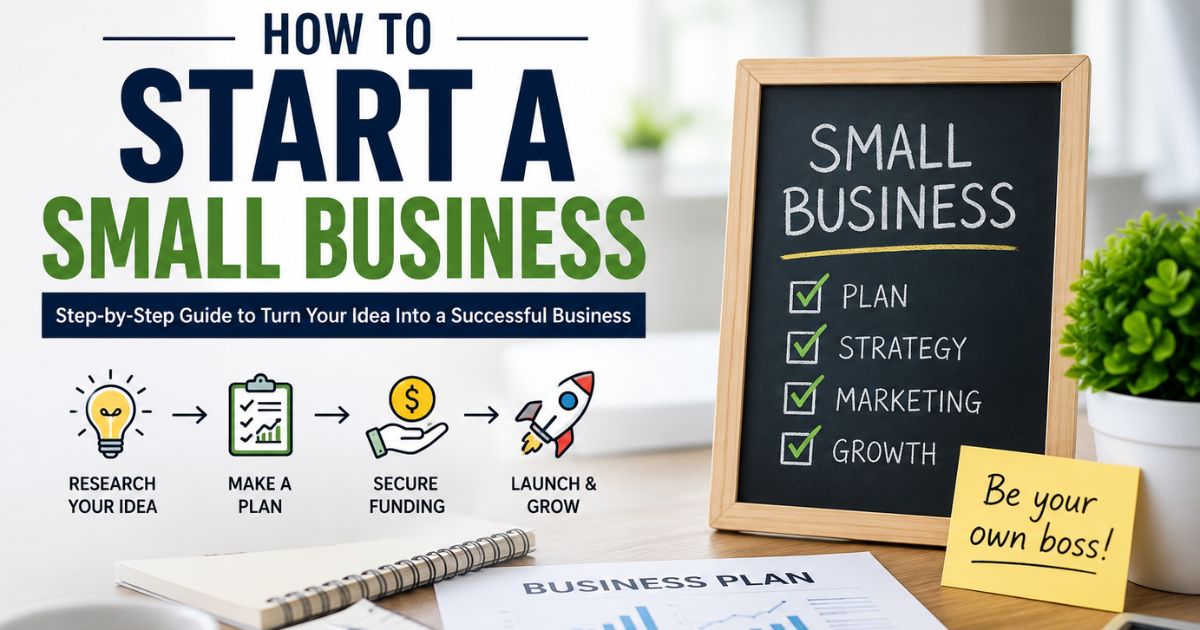

Starting a small business is one of the most rewarding decisions you’ll ever make, but it’s also one of the most challenging. Whether you’re turning a passion into profit, solving a problem you’ve personally experienced, or pursuing financial independence, the journey from concept to your first customer requires careful planning and execution.
This guide walks you through every critical step of launching a small business—from validating your idea and choosing the right structure to securing funding and making your first sale. You’ll learn what works, what doesn’t, and how to avoid the costly mistakes that sink most new ventures before they gain traction. By the end, you’ll have a clear action plan tailored to your specific situation, not generic advice that sounds good but fails in practice.
Validate Your Business Idea Before Investing Time and Money
Most business failures start with an unvalidated idea. You might love your concept, but if customers won’t pay for it, you don’t have a business—you have an expensive hobby.
Start with these validation steps:
- Identify a specific problem: Your business should solve a clear pain point for a defined group of people. “I want to start a bakery” is too vague. “I want to provide gluten-free baked goods to health-conscious families in my neighborhood” gives you something to test.
- Research your target market: Who exactly will buy from you? How many of them exist? What are they currently doing to solve this problem? Use free tools like Google Trends, local census data, and industry reports to size up your opportunity.
- Talk to potential customers: Before building anything, have 10-20 conversations with people who fit your ideal customer profile. Ask about their current frustrations, what they’ve tried, and what they’d pay for a better solution. Listen more than you pitch.
- Study your competition: Competitors aren’t necessarily bad—they prove demand exists. Visit their locations, buy their products, read their reviews. Note what customers love and what they complain about. Those gaps are your opportunities.
Test demand with minimal investment:
Create a simple landing page describing your offering and collect email signups. Run a small Facebook or Google ad campaign driving traffic to it. If you can’t get people interested for $100 in ad spend, you’ll struggle to build a sustainable business.
Offer your service manually before automating anything. If you want to start a meal prep business, cook for five customers first. Get feedback, refine your recipes, understand the real costs, and prove people will actually pay.
Choose the Right Business Structure for Your Situation
Your business structure affects your taxes, personal liability, paperwork requirements, and ability to raise money. There’s no universal “best” choice—it depends on your specific circumstances.
Sole Proprietorship
Best for: Solo operators testing an idea with minimal risk
How it works: You and your business are legally the same entity. No formal registration required in most cases—you’re automatically a sole proprietor when you start doing business.
Pros:
- Simplest and cheapest to set up
- Complete control over all decisions
- Straightforward tax filing (report on personal return)
Cons:
- Unlimited personal liability (creditors can pursue personal assets)
- Harder to raise outside funding
- Business dies with you
Limited Liability Company (LLC)
Best for: Most small businesses wanting liability protection without corporate complexity
How it works: Creates a legal separation between you and your business. Members (owners) aren’t personally liable for business debts.
Pros:
- Personal assets protected from business lawsuits and debts
- Flexible tax treatment (can choose corporation or pass-through taxation)
- Relatively simple to maintain
- More credible than sole proprietorship
Cons:
- Costs $50-$500 to form depending on state
- Annual fees and compliance requirements
- More paperwork than sole proprietorship
Corporation (C-Corp or S-Corp)
Best for: Businesses planning to raise significant capital or eventually sell
How it works: Creates a completely separate legal entity owned by shareholders.
Pros:
- Strongest liability protection
- Easier to raise money from investors
- Can offer stock options to employees
- Business continues regardless of ownership changes
Cons:
- Expensive to set up and maintain
- Complex tax filing requirements
- More regulatory oversight
- C-Corps face double taxation (corporate and personal level)
Practical recommendation: Most new small businesses should start as an LLC. It provides liability protection without excessive complexity. You can always convert to a corporation later if your needs change.
Write a Business Plan That Actually Helps You Succeed
Forget the 40-page document nobody reads. You need a working business plan that guides decisions and helps you secure funding if needed.
Your plan should answer these questions:
What exactly are you selling?
Describe your product or service in specific terms. Include pricing, how it’s delivered, and what makes it different from alternatives.
Who is your customer?
Create a detailed profile: demographics, behaviors, where they spend time, what they value, and why they’ll choose you.
How will you reach customers?
List specific marketing channels you’ll use, estimated costs, and expected customer acquisition costs. “Social media marketing” is too vague. “Instagram ads targeting parents in zip codes 10001-10010 interested in organic food” gives you something actionable.
What are your startup costs?
List every expense between now and opening day:
- Legal and registration fees
- Equipment and supplies
- Initial inventory
- Website and technology
- Marketing and advertising
- Insurance
- Working capital for first 3-6 months
What are your operating costs?
Monthly expenses once you’re running:
- Rent and utilities
- Payroll (including yourself)
- Materials and inventory
- Marketing
- Software and subscriptions
- Loan payments
How will you make money?
Project realistic revenue based on your market research. How many customers do you need? What’s your average transaction? Create three scenarios: conservative, moderate, and optimistic.
What’s your break-even point?
When will revenue cover all expenses? Most small businesses take 6-18 months to break even. If your model requires longer, you need more starting capital.
Keep your plan in a Google Doc or similar tool you’ll actually reference and update. It should evolve as you learn what works.
Secure Funding for Your Small Business
Most businesses require some capital to start. How much you need determines which funding sources make sense.
Bootstrap (Self-Funding)
Best for: Businesses requiring under $10,000 to start
Use personal savings, credit cards, or income from your current job. Maintain complete control and avoid debt, but limits how fast you can grow.
Tips for bootstrapping successfully:
- Start as a side project while employed
- Keep initial expenses minimal
- Reinvest early profits back into the business
- Negotiate payment terms with suppliers (pay in 30-60 days while collecting from customers immediately)
Friends and Family
Best for: Raising $5,000-$50,000 when you lack collateral for traditional loans
Make it professional:
- Put everything in writing
- Clearly state whether it’s a loan (with interest rate and repayment terms) or equity investment (percentage ownership they receive)
- Be transparent about risks
- Never accept money someone can’t afford to lose
Small Business Loans
Best for: Established businesses (even just 1-2 years) needing $25,000+
Options include:
SBA loans: Government-backed loans with favorable terms (5-25 year terms, 6-9% interest). Require good credit (680+), collateral, and detailed business plan. Slow approval (60-90 days).
Bank term loans: Traditional loans from commercial banks. Similar requirements to SBA loans but potentially faster approval.
Business lines of credit: Borrow up to a limit and only pay interest on what you use. Good for managing cash flow fluctuations.
Equipment financing: Loan secured by the equipment itself. Easier approval since the equipment is collateral.
Investors
Best for: High-growth businesses that can scale rapidly
Angel investors or venture capitalists provide capital in exchange for equity. You give up ownership and some control but gain expertise and connections along with money.
Only pursue this route if you’re building something that could grow 10x within 5 years. Investors need that return potential to justify their risk.
Crowdfunding
Best for: Consumer products with a compelling story
Platforms like Kickstarter let you pre-sell products and validate demand. You keep full ownership but need strong marketing skills to run a successful campaign.
Realistic funding expectations:
- Service businesses: $5,000-$20,000 (mostly bootstrap)
- Retail stores: $50,000-$250,000
- Restaurants: $250,000-$500,000
- Manufacturing: $100,000-$1,000,000+
Register Your Business and Handle Legal Requirements
The specific requirements vary by location and industry, but these steps apply to most small businesses.
Register Your Business Name
If operating as sole proprietor using your legal name: No registration required in most places.
If using a different name (DBA – “Doing Business As”): Register with your county clerk or state. Costs $10-$100.
If forming an LLC or corporation: File articles of organization/incorporation with your state. Your business name is registered as part of this process.
Before finalizing any name:
- Search your state’s business database to ensure it’s available
- Check if the .com domain is available
- Search USPTO trademark database to avoid infringing existing trademarks
Get Your Tax IDs
Federal Employer Identification Number (EIN): Required if you have employees, operate as corporation/LLC, or have certain excise tax obligations. Free from IRS website—takes 10 minutes.
State tax ID: Required in most states if you have employees or sell taxable goods. Apply through your state’s revenue department.
Apply for Licenses and Permits
Requirements vary dramatically by industry and location. Common examples:
General business license: Required by many cities and counties ($50-$400 annually)
Professional licenses: Required for contractors, cosmetologists, healthcare providers, real estate agents, and many other professions
Health permits: Required for food businesses, inspected by local health department
Building permits: Required for renovations or new construction
Signage permits: Required before installing outdoor signs in many municipalities
Zoning approval: Confirms your business type is allowed at your chosen location
Check requirements at three levels:
- Federal (most businesses have none)
- State (varies widely)
- Local (city and county)
Visit your city’s business portal or Small Business Development Center for a checklist specific to your situation.
Get Insurance Coverage
General liability insurance: Covers customer injuries and property damage. Essential for almost every business. Costs $400-$1,500 annually for most small businesses.
Professional liability insurance: Covers errors and negligence claims. Critical for consultants, designers, accountants, and professional services.
Property insurance: Covers your business property (equipment, inventory, furniture). Required if you have a lease or loan.
Workers’ compensation: Required by law if you have employees. Covers medical costs and lost wages for work-related injuries.
Commercial auto insurance: Required if employees drive for business purposes.
Don’t skimp on insurance. A single lawsuit can destroy an uninsured business.
Set Up Your Financial Systems Properly from Day One
Poor financial management kills more small businesses than bad products. Set up these systems before your first transaction.
Open a Business Bank Account
Never mix personal and business finances. It creates tax nightmares and pierces the liability protection of LLCs and corporations.
What you’ll need:
- EIN or Social Security Number
- Business formation documents
- Business license
- Identification
Compare banks on monthly fees, transaction limits, and whether they offer merchant services if you need to accept cards.
Choose Accounting Software
For most small businesses: QuickBooks Online or Xero ($15-$50/month)
For very simple businesses: Wave (free) or FreshBooks
Connect your bank account so transactions import automatically. Categorize everything correctly from the start. Fixing a year of messy books costs thousands in accountant fees.
Set Up Payment Processing
For online sales: Stripe or PayPal (2.9% + $0.30 per transaction)
For in-person sales: Square, Clover, or Toast (2.6-2.9% + $0.10 per transaction)
For B2B sales: Consider ACH payments (lower fees) or net-30 payment terms
Factor processing fees into your pricing. That 3% adds up quickly.
Establish a Tax Payment System
Small businesses typically pay:
Federal income tax: Quarterly estimated payments if you expect to owe $1,000+
State income tax: Quarterly estimated in most states
Self-employment tax: 15.3% on net earnings (covers Social Security and Medicare)
Sales tax: Collected from customers and remitted monthly, quarterly, or annually depending on volume
Payroll taxes: Due semi-weekly or monthly if you have employees
Set aside 25-30% of revenue in a separate savings account for taxes. Missing tax payments triggers penalties that spiral quickly.
Track Everything
Keep records of:
- All income (invoices, sales receipts, bank deposits)
- All expenses (receipts, invoices, credit card statements)
- Mileage if you drive for business
- Home office percentage if you work from home
- Asset purchases (equipment, furniture, technology)
Store digital copies in cloud storage. You need these for taxes, loan applications, and if you’re ever audited.
Build Your Brand Identity and Online Presence
Your brand is how customers perceive you. It’s not just a logo—it’s the entire experience of doing business with you.
Develop Your Brand Foundation
Business name: Memorable, easy to spell, and relevant to what you do
Tagline: One sentence explaining what you do and for whom
Value proposition: Why customers should choose you over alternatives
Brand voice: How you communicate (professional, friendly, humorous, authoritative)
Visual identity:
- Logo (hire a designer on Fiverr for $50-$200 or use Canva for DIY)
- Color palette (2-3 primary colors)
- Fonts (one for headings, one for body text)
- Image style
Consistency matters more than perfection. A simple brand used consistently beats an expensive brand used inconsistently.
Create Your Website
Every business needs a website. Even if you sell primarily in-person, customers research online before visiting.
Essential pages:
Homepage: What you do, who you serve, and clear next step (call, buy, schedule)
About: Your story, credentials, and why customers should trust you
Products/Services: What you offer with clear descriptions and pricing
Contact: Phone, email, physical address, hours, contact form
Platform options:
Shopify ($29-299/month): Best for e-commerce
WordPress with hosting ($10-30/month): Most flexible, requires more technical skill
Squarespace ($16-49/month): Best for service businesses and portfolios
Wix ($16-159/month): Easiest for beginners
Your website doesn’t need to be fancy. It needs to clearly communicate what you do, build trust, and make it easy for customers to take the next step.
Set Up Google Business Profile
Free and essential for local businesses. Appears in Google Maps and local search results.
Complete every section:
- Accurate business hours
- Phone number and website
- Business category
- Photos of your location, products, and team
- Regular posts about offers and updates
Encourage satisfied customers to leave reviews. Businesses with 40+ reviews and 4+ star ratings see significantly more calls and visits.
Establish Social Media Presence
Don’t try to be everywhere. Choose 1-2 platforms where your customers actually spend time.
Instagram: Visual businesses (retail, food, beauty, design)
Facebook: Local businesses, older demographics
LinkedIn: B2B services, professional services, consulting
TikTok: Young consumers, entertainment, education
Pinterest: Home decor, fashion, recipes, crafts
Post consistently (3-5 times per week minimum) with a mix of:
- Educational content (tips, how-tos)
- Behind-the-scenes
- Customer testimonials
- Product showcases
- Community engagement
Social media builds brand awareness. It rarely drives immediate sales for most small businesses. Be patient and focus on building genuine connections.
Develop Your Marketing Strategy and Customer Acquisition Plan
Marketing isn’t one thing—it’s everything you do to attract, convert, and retain customers.
Identify Your Marketing Channels
For local service businesses:
Google Local Services Ads: Pay-per-lead ads appearing above regular search results. Excellent ROI for home services, legal, and professional services.
Local SEO: Optimize your website and Google Business Profile to rank for “[your service] near me” searches.
Direct mail: Still works for home services in specific neighborhoods. Target new movers or high-value zip codes.
Partnerships: Connect with complementary businesses for referrals (real estate agents + home inspectors, wedding photographers + florists).
For e-commerce businesses:
Google Shopping Ads: Showcase products directly in search results. Start here before social ads.
Facebook/Instagram Ads: Visual products with broad appeal. Expect to spend $1,000-$2,000 testing before you find winning campaigns.
Influencer partnerships: Micro-influencers (10K-100K followers) often deliver better ROI than celebrities.
Email marketing: Build a list from day one. Email drives 20-40% of revenue for successful e-commerce businesses.
For B2B service businesses:
LinkedIn outreach: Direct messages to decision-makers in target companies.
Content marketing: Blog posts, videos, and guides demonstrating expertise. Slow to build but compounds over time.
Networking: Industry events, chambers of commerce, business groups.
Cold outreach: Email or phone calls to ideal prospects. Still works if you provide value and personalize.
Set a Marketing Budget
Typical small business marketing budgets range from 5-15% of projected revenue in year one.
If you project $100,000 in first-year revenue, plan to spend $5,000-$15,000 on marketing.
Businesses in competitive industries (restaurants, retail) need higher percentages. B2B businesses with long sales cycles can often start lower.
Allocate your budget across:
- Paid advertising (40-50%)
- Website and content (20-30%)
- Tools and software (10-20%)
- Networking and events (10-20%)
Track every dollar. Know your customer acquisition cost (how much you spend to get one customer) and customer lifetime value (how much an average customer spends over their relationship with you). If acquisition cost exceeds lifetime value, your business won’t survive.
Create a Content Marketing System
Content builds trust and attracts customers searching for solutions.
Identify 10-15 questions your ideal customers ask. Create detailed answers as blog posts, videos, or guides.
For a landscaping business:
- “How much does landscaping cost?”
- “Best low-maintenance plants for [your region]”
- “Should I aerate my lawn in spring or fall?”
For a bookkeeping service:
- “What accounting software should I use for my small business?”
- “How to organize receipts for taxes”
- “Difference between bookkeeping and accounting”
Publish consistently. One comprehensive piece per week beats seven rushed pieces.
Optimize for search. Use natural language matching how people search. Answer questions completely. Include relevant examples and specifics.
Repurpose everything. Turn a blog post into a video, email, social posts, and podcast episode.
Hire Your First Employees or Contractors
Hiring transforms your business from self-employment to true entrepreneurship. It also introduces complexity, cost, and risk.
Decide: Employee or Contractor?
Independent contractors:
- You control the result, not how they work
- They use their own tools and equipment
- They work for multiple clients
- You pay agreed rate; they handle their own taxes
- No benefits required
- Can terminate relationship anytime
Employees:
- You control when, where, and how they work
- You provide tools and equipment
- They work primarily for you
- You withhold taxes and provide W-2
- May require benefits
- Employment laws apply
Misclassifying employees as contractors triggers serious IRS penalties. When in doubt, treat them as employees.
Your First Hire Should Solve Your Biggest Bottleneck
Don’t hire to avoid tasks you dislike. Hire to remove genuine growth constraints.
If you’re drowning in service delivery: Hire someone to fulfill services so you can focus on sales and operations.
If you have demand but can’t handle volume: Hire operational help.
If operations run smoothly but growth stalled: Hire for sales and marketing.
Start part-time or project-based. Test the relationship before committing to full-time employment.
Where to Find Good People
Your network: Ask friends, existing customers, and business connections for referrals. Referrals outperform job board applicants.
Industry-specific job boards: Better candidate quality than general boards.
Local colleges: Interns and recent graduates bring energy and fresh perspectives.
Indeed and LinkedIn: Cast a wide net but expect to sort through many applications.
Write specific job descriptions. “Looking for a motivated self-starter” attracts nobody. “Seeking dental hygienist with 2+ years experience, comfortable with children, available Tuesday-Saturday” attracts the right people.
Set Up Payroll Properly
Use payroll software: Gusto, ADP, Paychex, or QuickBooks Payroll handle calculations, tax withholding, and filing automatically ($40-$150/month base plus per-employee fees).
Register for:
- State unemployment insurance
- Workers’ compensation insurance
- State new hire reporting
Establish pay schedule: Weekly, bi-weekly, or monthly. Stick to it religiously.
Create an employee handbook covering:
- Pay and benefits
- Time off policies
- Workplace behavior expectations
- Termination procedures
Missing payroll or mishandling payroll taxes ranks among the fastest ways to kill your business. Don’t DIY this unless you have extensive experience.
Launch Your Business and Get Your First Customers
You’ve done the preparation. Now it’s time to open the doors and generate revenue.
Create a Launch Plan
Soft launch: Open quietly to work out operational issues. Serve friends, family, and a small initial audience. Get feedback and fix problems before the official launch.
Official launch: Bigger marketing push once you’re confident operations run smoothly.
Launch tactics that work:
Limited-time offer: 20% off for first 50 customers, free upgrade for launch week, or buy-one-get-one promotion.
Launch event: Grand opening with food, demos, or entertainment. Invite local media, influencers, and potential customers.
Email announcement: Send to everyone in your network. Make it personal and ask them to share with people who might benefit.
Social media campaign: Daily posts counting down to launch. Behind-the-scenes content. Live video on launch day.
Local media outreach: Send press release to local newspapers, TV stations, and bloggers. Small-town media especially loves covering new local businesses.
Partner promotions: Partner with complementary businesses for cross-promotion.
Get Your First Ten Customers
The first ten are the hardest. After that, momentum builds.
Personal network: Tell everyone you know. Don’t be shy. Most will want to support you.
Direct outreach: Identify 100 ideal customers. Reach out personally via email, phone, or social media. Offer special launch pricing.
Show up in person: Farmers markets, trade shows, networking events, and community gatherings put you directly in front of potential customers.
Solve one problem exceptionally well: Don’t try to be everything to everyone. Become known as the absolute best solution for one specific problem.
Deliver exceptional experiences: Your first customers become your best marketing. Exceed expectations. Follow up personally. Ask for feedback. Turn them into advocates who refer others.
Ask for Reviews and Referrals
Immediately after delivery, ask satisfied customers:
“I’m so glad you’re happy with [result]. Would you mind sharing your experience in a quick Google review? It helps other people find us.”
Most people are willing if you ask at the right moment. Make it easy:
- Send a direct link to your review page
- Provide a template if they’re unsure what to write
- Thank them genuinely
For referrals:
“We’re trying to help more people like you. Who else do you know dealing with [problem you solve]?”
Offer referral incentives ($25 credit, 10% off next purchase, free upgrade) but never pay for reviews.
Common Mistakes New Small Business Owners Make
Underestimating Startup Costs
Most entrepreneurs estimate expenses accurately but forget irregular costs: annual insurance, quarterly taxes, equipment repairs, marketing tests that fail, seasonal inventory fluctuations.
Add 30-50% buffer to your initial cost estimate. Running out of money before reaching profitability kills businesses with good products and eager customers.
Trying to Do Everything Yourself
Your time has value. Spending 10 hours learning basic accounting software when a bookkeeper charges $200/month makes no sense if those 10 hours could generate revenue.
Outsource tasks outside your expertise unless budget absolutely requires DIY.
Inconsistent Marketing
Marketing one week then stopping when you get busy creates feast-or-famine cycles. Your pipeline should always be filling even when you’re busy with current work.
Block time weekly for marketing activities regardless of current workload.
Poor Pricing
Underpricing to win customers creates unsustainable businesses. Calculate actual costs including your time, then add appropriate profit margin.
Raising prices later is harder than starting higher. It’s easier to discount selectively than raise baseline prices.
Neglecting Legal Protection
Operating without proper insurance, contracts, or business structure works fine until something goes wrong. Then it destroys everything you’ve built.
Spend money on proper legal setup and protection. It’s not optional.
Ignoring Cash Flow
Profit and cash are different. You can be profitable on paper while running out of cash to pay bills.
If you send invoices with net-30 terms but pay suppliers immediately, you need working capital to bridge the gap. Track cash flow weekly.
No Written Processes
When everything lives in your head, you can’t scale, take time off, or maintain consistency. Document how you do recurring tasks.
Create checklists, templates, and standard operating procedures as you go. Future you (and future employees) will be grateful.
Frequently Asked Questions
How much money do I need to start a small business?
Depends entirely on business type. Service businesses often start with $5,000-$10,000. Retail stores need $50,000-$100,000. Restaurants require $250,000+. Start with minimal viable version and grow as revenue allows. Many successful businesses started with under $1,000 by focusing on service delivery before infrastructure.
Should I quit my job before starting a business?
Keep your job while testing and validating your idea. Start as a side project, prove customers will pay, establish some revenue momentum, then transition. Quitting immediately adds financial pressure that leads to poor decisions. Exception: businesses requiring immediate full-time commitment (like buying an existing business).
How long until my business becomes profitable?
Most small businesses take 6-18 months to break even and 2-3 years to provide stable owner income. Service businesses with low overhead reach profitability faster. Retail and manufacturing take longer. Plan to support yourself through other means initially.
Do I need a business partner?
Only if they bring skills, resources, or connections you lack and can’t acquire otherwise. Choose partners carefully—breaking up a partnership is harder than divorce. Use a detailed operating agreement outlining roles, equity split, decision-making authority, and exit procedures.
What if someone steals my business idea?
Ideas matter less than execution. Dozens of people might have similar ideas, but success comes from implementation, customer service, and adaptation. Focus on building rather than protecting. For truly novel inventions, consult a patent attorney, but most small businesses don’t need patents.
How do I know if my business is working?
Track these metrics:
- Customer acquisition cost vs. customer lifetime value
- Monthly recurring revenue (if applicable)
- Cash runway (months until you run out of money)
- Customer retention rate
- Time to profitability
If costs to acquire customers exceed what they spend with you, something needs to change. If you’re not progressing toward profitability, reassess your model.
Should I start an online or physical business?
Depends on what you’re selling and your target market. Online businesses have lower overhead and broader reach but face intense competition. Physical locations build stronger local connections but cost more to operate. Many successful small businesses combine both—physical location with online ordering and shipping.
What’s the best business to start with little money?
Service businesses requiring your expertise and minimal equipment: consulting, virtual assistance, writing, design, tutoring, personal training, cleaning, lawn care, photography. Trade skills for initial necessities rather than paying cash. A web designer might trade services with a photographer for headshots.
How many hours will I work?
Expect 50-70 hours weekly in the first year, especially if bootstrapping. As you hire, systematize, and establish momentum, this decreases. Some small business owners never reduce hours—they scale their impact instead. Be honest about your lifestyle goals and build accordingly.
What if I fail?
Most entrepreneurs fail at least once. Business failure doesn’t equal personal failure. You gain skills, connections, and knowledge that increase success odds in your next venture. Minimize financial risk by keeping debt low, maintaining emergency funds, and testing before fully committing. Even if this business doesn’t work, the experience is valuable.
Key Takeaways for Starting Your Small Business
Starting a small business requires thorough planning, adequate funding, proper legal setup, and realistic expectations about the work involved.
Before spending money:
- Validate your idea with real customer conversations
- Research competition and market size
- Calculate total costs including 6 months working capital
Get the foundations right:
- Choose appropriate business structure (LLC for most)
- Register properly and get necessary licenses
- Set up separate business finances from day one
- Obtain adequate insurance coverage
Launch strategically:
- Start with minimum viable offering
- Focus on getting first 10 customers through personal outreach
- Deliver exceptional experiences that generate reviews and referrals
- Market consistently even when busy
Avoid common mistakes:
- Underestimating costs and timeline to profitability
- Poor pricing that doesn’t cover true costs
- Mixing personal and business finances
- Trying to do everything yourself
- Inconsistent marketing creating feast-famine cycles
Success comes from solving real problems for specific people, delivering value that exceeds cost, and operating with enough capital to survive while building momentum. The businesses that thrive focus relentlessly on customer needs, track metrics honestly, and adapt quickly when something isn’t working.
Moving Forward With Your Business
Starting a small business represents one of the most significant decisions you’ll make. The journey challenges you financially, emotionally, and intellectually. It also offers rewards beyond just profit—autonomy, creative expression, and the satisfaction of building something valuable.
The information in this guide gives you a solid foundation, but learning continues throughout your business’s life. Stay curious, connect with other entrepreneurs, and remember that every successful business owner once stood exactly where you are now, wondering if they could actually do this.
They could. You can too.
Your next step is simple: choose one action from this guide and complete it this week. Register your business name, talk to three potential customers, or set up your business bank account. Progress happens one deliberate step at a time.
The best time to start was five years ago. The second best time is now.