
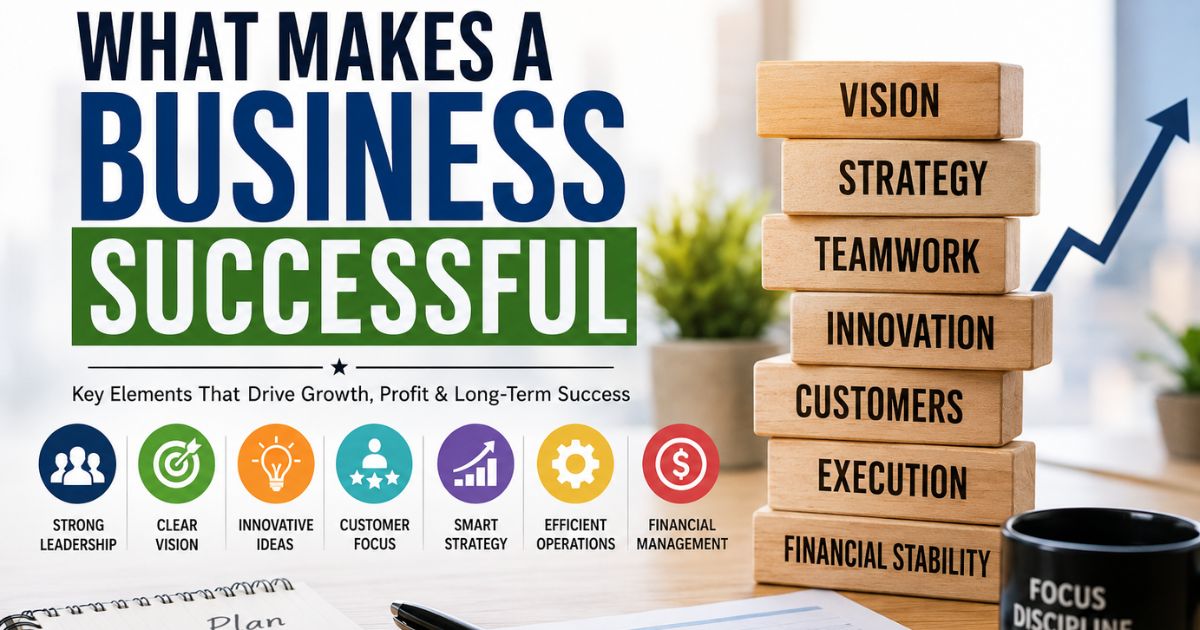

Running a business is brutally difficult. Most fail within their first five years, not because their ideas are bad, but because they overlook fundamental principles that separate thriving companies from struggling ones. Success isn’t accidental—it’s the result of deliberately executing specific strategies while maintaining flexibility to adapt.
Whether you’re launching your first venture or scaling an established company, understanding what truly drives business success helps you allocate resources wisely, avoid costly mistakes, and build something sustainable. This guide breaks down the core factors that consistently distinguish successful businesses from failures, offering practical frameworks you can implement immediately. You’ll learn what actually matters versus what sounds good in theory, backed by principles that work across industries and market conditions.
Clear Vision and Strategic Direction
Successful businesses know exactly where they’re going. This isn’t about crafting inspiring mission statements for the boardroom wall—it’s about having a concrete vision that guides every decision you make.
Your vision should answer three questions: What problem are you solving? Who are you solving it for? What will your business look like when you succeed?
Strategic direction translates this vision into actionable plans. You need clear objectives for the next quarter, year, and three years. These goals must be specific enough that anyone in your organization understands what you’re trying to achieve.
Companies without clear direction make inconsistent decisions. They chase every opportunity, spread resources thin, and confuse customers with mixed messages. Your team can’t execute effectively if they don’t understand the destination.
Key elements of strong strategic direction:
- Defined target market with specific customer profiles
- Measurable goals tied to revenue, growth, or market position
- Clear priorities that guide resource allocation
- Documented decision-making criteria aligned with your vision
- Regular strategic reviews to adjust based on market feedback
The most successful businesses revisit their strategy quarterly, not annually. Markets move fast, and rigid plans become obsolete. Build flexibility into your strategic framework while maintaining consistency in your core purpose.
Deep Understanding of Your Customer
You cannot build a successful business without truly understanding the people you serve. This goes far beyond basic demographics—you need to know their problems, motivations, buying behaviors, and decision-making processes.
Businesses fail when they fall in love with their product instead of their customer’s problem. You might create something technically impressive that nobody wants to buy. The market doesn’t care about your solution until it clearly addresses their specific pain points.
Successful businesses obsess over customer feedback. They constantly gather data through conversations, surveys, support tickets, and behavioral analytics. This information shapes product development, marketing messages, and service improvements.
Methods to deepen customer understanding:
- Conduct regular one-on-one customer interviews
- Analyze purchase patterns and usage data
- Monitor customer service interactions for recurring themes
- Study why customers leave or don’t convert
- Create detailed buyer personas based on real data
- Track customer lifetime value by segment
The businesses that dominate their markets can predict what customers need before they ask. Amazon built this capability into their entire operation. They use purchasing data to anticipate demand, personalize recommendations, and optimize the customer experience at every touchpoint.
Don’t assume you know what customers want. Test your assumptions constantly. Many businesses discover that what they think customers value differs dramatically from what actually drives purchase decisions.
Strong Value Proposition
Your value proposition answers one critical question: Why should someone buy from you instead of your competitors or stick with the status quo?
A strong value proposition is specific, quantifiable, and immediately clear. “We help businesses grow” is worthless. “We help B2B software companies reduce customer acquisition costs by 40% through targeted content marketing” communicates exactly what you do and for whom.
Your value proposition must address the gap between what customers currently experience and what they want. This gap represents the transformation you deliver. The wider and more painful the gap, the more valuable your solution becomes.
Components of an effective value proposition:
- Specific target customer with defined characteristics
- Clear problem or desire you address
- Tangible benefits with measurable outcomes
- Distinct differentiation from alternatives
- Proof points that build credibility
Test your value proposition with real prospects. If you can’t explain it in under 30 seconds and have them immediately understand the benefit, it’s too complicated. Clarity beats cleverness every time.
The businesses that grow fastest nail their value proposition early and communicate it consistently across every customer touchpoint. Everyone from sales to support should articulate the same core benefits in their own words.
Financial Discipline and Cash Flow Management
Profitability doesn’t guarantee success, but running out of cash guarantees failure. More businesses die from cash flow problems than from lack of profitability.
Financial discipline means knowing your numbers intimately. You need real-time visibility into revenue, expenses, margins, and cash position. Successful business owners review financial metrics weekly, not monthly. By the time monthly reports arrive, you’ve lost opportunities to correct problems.
Cash flow management requires understanding the timing of money in and out of your business. You can be profitable on paper while going bankrupt in reality if customers pay slowly while your bills come due immediately.
Critical financial metrics to track:
- Gross profit margin by product or service line
- Operating expenses as a percentage of revenue
- Cash conversion cycle
- Customer acquisition cost versus lifetime value
- Burn rate and runway (for growth-stage businesses)
- Working capital requirements
Set up financial controls before you need them. Establish approval processes for spending, regular forecasting practices, and clear accountability for budget management. These systems feel bureaucratic when you’re small but become essential as you scale.
The most successful businesses maintain adequate reserves to weather unexpected challenges. A common benchmark is 3-6 months of operating expenses in readily available cash. This buffer lets you make strategic decisions instead of desperate ones when problems arise.
Never confuse revenue with profit or profit with cash. They measure different things, and misunderstanding the distinction has destroyed countless businesses that looked successful on the surface.
Exceptional Product or Service Quality
No amount of marketing or sales skill compensates for a mediocre product. Customers might buy once based on your pitch, but they only come back if you deliver real value.
Quality doesn’t mean perfection or endless features. It means consistently meeting or exceeding customer expectations for what they actually care about. A budget airline succeeds by reliably delivering cheap flights on time, not by offering luxury amenities.
Successful businesses define quality standards based on customer priorities, then build systems to deliver consistently. They measure quality through customer satisfaction scores, retention rates, and referral rates—not through internal assessments of how good they think they are.
Quality management practices:
- Documented standards for what “good” looks like
- Regular quality audits and testing
- Customer feedback loops integrated into improvement processes
- Investment in training and tools that enable quality delivery
- Clear accountability for quality outcomes
The compound effect of quality creates competitive moats. When customers trust you to deliver consistently, they stop shopping around. When they become advocates who refer others, your customer acquisition costs drop while your growth accelerates.
Poor quality creates a death spiral. You spend money acquiring customers who don’t stay, leaving no resources to fix the underlying problems. You’re perpetually replacing churned customers instead of building on a loyal base.
Build quality into your processes from the start. It’s exponentially harder to fix quality problems after you’ve scaled than to design them out early. Every shortcut you take to ship faster or cut costs shows up in customer satisfaction and retention.
Effective Marketing and Customer Acquisition
The best product in the world fails if nobody knows it exists. Successful businesses master the art and science of attracting and converting their ideal customers.
Effective marketing starts with a clear understanding of where your customers spend attention and how they make buying decisions. You don’t need to be everywhere—you need to be where your customers are, with messages that resonate with their specific needs.
Customer acquisition requires testing different channels, messages, and offers to discover what works for your specific business. What works for competitors might fail for you. Data beats assumptions every time.
Core marketing capabilities:
- Clear positioning that differentiates you in the market
- Content that educates and builds trust with prospects
- Multiple acquisition channels to reduce dependency
- Conversion optimization across the customer journey
- Attribution tracking to understand what drives results
- Messaging aligned with customer language and priorities
Successful businesses know their customer acquisition costs by channel and can predict how much revenue each marketing dollar generates. This data-driven approach lets them scale what works and eliminate what doesn’t.
The most effective marketing feels helpful, not salesy. When you educate prospects, solve smaller problems for free, and demonstrate expertise, they trust you with bigger purchases. This approach takes longer but builds sustainable advantages.
Avoid the trap of chasing tactics without strategy. Every week brings new marketing channels and techniques. Without a clear strategy anchored in customer understanding, you waste resources bouncing between trends instead of building momentum.
Strong Leadership and Company Culture
Your business will never outperform your leadership capabilities. The companies that dominate markets have leaders who continuously develop their skills and create environments where talented people thrive.
Leadership isn’t about charisma or vision statements. It’s about making good decisions consistently, developing people, and maintaining focus during both success and adversity. The best leaders build systems that work without their constant involvement.
Company culture determines how people behave when nobody’s watching. It’s not about ping pong tables or casual Fridays—it’s about shared values that guide decisions, how conflicts get resolved, and whether people feel ownership over outcomes.
Elements of strong leadership:
- Clear communication of priorities and expectations
- Accountability structures with consequences for performance
- Decision-making frameworks that empower teams
- Investment in developing people’s capabilities
- Consistency between stated values and actual behavior
- Willingness to make difficult decisions quickly
Culture problems multiply as you grow. A toxic culture might not kill a five-person company, but it destroys organizations at scale. The values and behaviors you tolerate early become baked into your DNA.
Successful leaders hire people smarter than themselves and create conditions for those people to succeed. They focus on building systems and developing capabilities rather than being the hero who solves every problem.
The businesses that last decades maintain cultural consistency while adapting strategies. Employees and customers know what the company stands for, creating trust and loyalty that transcend individual products or market conditions.
Operational Excellence and Efficiency
Successful businesses run on well-designed systems, not heroic individual effort. As you scale, the quality of your operations determines whether growth creates value or chaos.
Operational excellence means you can deliver your product or service consistently, efficiently, and profitably. You’ve documented processes for critical activities, identified bottlenecks, and continuously improve based on data.
Efficiency isn’t about cutting costs blindly—it’s about maximizing output from available resources. This might mean investing in automation, training, or tools that have upfront costs but improve long-term productivity.
Operational capabilities that drive success:
- Documented processes for critical workflows
- Metrics that measure productivity and quality
- Regular process reviews to identify improvements
- Technology infrastructure that scales with growth
- Supply chain reliability and backup options
- Quality control systems that catch problems early
The businesses that scale successfully build operational discipline early. They create standard operating procedures, train people properly, and measure what matters. This foundation lets them grow without proportionally increasing complexity.
Poor operations create invisible costs. Time wasted on rework, customer frustration from inconsistent experiences, and employee burnout from chaotic workflows all drain profitability and slow growth.
Focus on eliminating friction in your highest-volume or highest-value activities first. A small improvement in something you do hundreds of times compounds dramatically. Don’t try to optimize everything at once—prioritize based on impact.
Adaptability and Innovation
Markets evolve constantly. Customer preferences shift. Technology disrupts industries. Successful businesses adapt or die.
Adaptability doesn’t mean chasing every trend—it means monitoring your environment for meaningful changes and responding appropriately. You need systems to detect signals that matter while filtering out noise.
Innovation isn’t just about groundbreaking inventions. It includes incremental improvements to products, processes, and customer experiences. The businesses that innovate consistently maintain competitive advantages over time.
Building adaptability into your business:
- Regular market research and competitive analysis
- Experimentation budget for testing new approaches
- Culture that tolerates intelligent failure
- Customer feedback loops that surface changing needs
- Diverse perspectives in strategic discussions
- Willingness to cannibalize existing products for better ones
The most dangerous position is being successful with an outdated model. Blockbuster dominated video rental until they didn’t. Kodak owned photography until digital cameras destroyed their business. Both saw the changes coming but couldn’t adapt quickly enough.
Create space for innovation separate from daily operations. When everyone’s consumed with executing current business, nobody has capacity to build what’s next. The most successful companies dedicate resources to both running today’s business and creating tomorrow’s.
Listen to dissenting voices and uncomfortable data. If customer complaints highlight emerging problems or sales teams report new objections, these signals often predict larger market shifts. Dismissing feedback because it challenges your assumptions is how leaders get blindsided.
Strategic Talent Acquisition and Development
Your people determine what’s possible. Successful businesses attract, develop, and retain talent better than competitors.
Strategic hiring means recruiting not just for current needs but for future capabilities. The person who’s perfect for your startup phase might not scale with the business. Being honest about this reality helps everyone make better decisions.
Most businesses hire too slowly and fire too slowly. They leave critical positions open too long, settling for mediocre candidates out of desperation. They tolerate underperformers too long, hoping they’ll improve while team morale suffers.
Talent strategies that drive success:
- Clear role definitions with specific outcomes
- Structured interview processes that assess real capabilities
- Competitive compensation aligned with market rates
- Professional development opportunities
- Performance management systems with regular feedback
- Succession planning for critical positions
The businesses that win talent wars offer more than money. They provide opportunities for growth, autonomy over work, and missions people find meaningful. Culture and development opportunities often matter more than salary for top performers.
Invest heavily in onboarding. How you integrate new hires in their first 90 days determines their long-term success and engagement. Rushed onboarding creates confusion, mistakes, and early turnover.
Don’t tolerate brilliant jerks who deliver results while poisoning culture. Short-term performance gains aren’t worth long-term cultural damage. The best teams combine strong individual talent with genuine collaboration.
Customer Retention and Relationship Building
Acquiring customers costs money. Retaining customers generates profit. Businesses that prioritize retention over acquisition grow more sustainably and profitably.
Customer retention requires delivering consistent value, addressing problems quickly, and continuously improving based on feedback. Every interaction either strengthens or weakens the relationship.
The economics of retention are compelling. Depending on industry, acquiring new customers costs 5-25 times more than retaining existing ones. Small improvements in retention rates compound into significant revenue impacts.
Retention strategies that work:
- Proactive customer success programs that ensure outcomes
- Regular check-ins to identify issues before they become problems
- Loyalty programs that reward ongoing relationships
- Continuous product improvements based on customer feedback
- Personalized communication that demonstrates you know them
- Quick, empathetic resolution when things go wrong
Successful businesses measure retention metrics obsessively. They track churn rates, customer lifetime value, net promoter scores, and renewal rates. They segment customers to understand which types stay longest and generate most value.
The relationship doesn’t end at the sale. That’s when it begins. Companies that treat purchases as transactions rather than relationship starts leave money on the table and create opportunities for competitors.
Build feedback loops at every stage of the customer journey. Survey new customers, long-term customers, and lost customers. Each group provides different insights into what works and what needs improvement.
Data-Driven Decision Making
Intuition matters, but data keeps you honest. Successful businesses combine experience-based judgment with rigorous analysis of what’s actually happening.
Data-driven decision making means establishing metrics for key activities, regularly reviewing performance, and adjusting based on evidence rather than assumptions. You test hypotheses instead of arguing about opinions.
The most successful businesses build data literacy across the organization. Leaders understand enough about analytics to ask good questions and interpret results. Teams have access to relevant metrics and understand how their work impacts key numbers.
Building a data-driven culture:
- Identify key performance indicators for each function
- Create dashboards that make metrics visible
- Establish regular review cadences for different metrics
- Train people to interpret and act on data
- Document experiments and their results
- Balance quantitative data with qualitative insights
Don’t drown in data. Focus on metrics that drive decisions and predict outcomes. Vanity metrics might look impressive but don’t inform action. The right ten metrics tell you more than monitoring hundreds.
The businesses that excel at using data don’t just report what happened—they predict what will happen and identify why things occur. This analytical sophistication creates competitive advantages in everything from inventory management to customer acquisition.
Build experimentation into your operating model. Test different approaches, measure results rigorously, and scale what works. A culture of testing prevents you from falling in love with strategies that don’t deliver results.
Common Mistakes That Undermine Business Success
Understanding what makes businesses successful is only half the equation. Recognizing what causes failure helps you avoid predictable traps.
Growing too fast without infrastructure: Scaling revenue before you can deliver quality or manage operations creates disasters. Disappointed customers, burned-out employees, and cash flow crises often stem from premature scaling.
Ignoring unit economics: Businesses that lose money on each transaction can’t make it up in volume. If your customer acquisition cost exceeds lifetime value, you’re building a money-losing machine. Fix economics before scaling.
Failing to differentiate: Competing solely on price in commoditized markets is a race to the bottom. Without clear differentiation, you become interchangeable and your margins compress.
Neglecting cash flow: Profitable companies go bankrupt when they run out of cash. Monitor cash flow as closely as revenue. Understand your cash conversion cycle and plan for seasonal variations.
Not firing fast enough: Keeping underperformers demoralizes top performers and delays finding the right person. Cultural fit and performance issues rarely resolve themselves.
Following competitors instead of customers: What works for competitors might not work for you. Understand why they make certain choices rather than blindly copying tactics.
Overcomplicating the business model: Complexity creates confusion for customers and employees. The simplest viable model is usually the best model.
Underinvesting in marketing: Great products don’t sell themselves. Budget adequately for customer acquisition and brand building, especially in the early stages.
Losing focus: Chasing too many opportunities simultaneously dilutes resources and confuses positioning. Success requires saying no to good opportunities to focus on great ones.
Frequently Asked Questions
What is the single most important factor that makes a business successful?
There’s no single factor—successful businesses excel across multiple dimensions simultaneously. However, if forced to prioritize, deep understanding of your customer and relentless focus on delivering them value creates the foundation for everything else. Without customers who value what you offer enough to pay for it, nothing else matters.
How long does it take for a business to become successful?
Timeline varies dramatically by industry, business model, and definition of success. Most businesses take 2-3 years to become profitable and 5-7 years to establish market position and sustainable growth. Overnight successes usually involve years of invisible groundwork. Focus on building solid foundations rather than arbitrary timelines.
Can a business be successful without innovation?
Yes, but only temporarily. Many businesses succeed initially by executing basics better than competitors—superior customer service, operational efficiency, or market positioning. However, markets evolve, customer needs change, and competitors improve. Without ongoing innovation in products, processes, or business models, advantages erode over time.
What role does luck play in business success?
Luck certainly matters, but preparation determines whether you recognize and capture lucky breaks. Successful businesses create conditions where luck can happen—they network actively, try different approaches, and stay alert to opportunities. You can’t control luck, but you can maximize your exposure to potential lucky events.
How much money do you need to start a successful business?
Requirements vary enormously based on business type. Service businesses often start with minimal capital—sometimes under $5,000. Manufacturing or retail businesses might require $50,000-$500,000 or more. The critical factor isn’t the amount but understanding your specific cash requirements and having adequate runway to reach profitability.
Is a business degree necessary for business success?
No. Many successful entrepreneurs lack formal business education. However, you must develop business skills somehow—through experience, mentorship, self-study, or formal education. Understanding finance, marketing, operations, and strategy matters more than where you learned these disciplines.
How do you know if your business idea will be successful?
You don’t know until you test it with real customers. Validate demand before investing heavily by selling to early customers, conducting thorough market research, and starting small. Customer willingness to pay, not enthusiasm for your idea, determines commercial viability.
What’s the difference between a successful business and a profitable one?
Profitability is one measure of success but not the only one. A business might be profitable while declining in market share, burning out employees, or becoming obsolete. True success combines profitability with sustainable growth, customer satisfaction, employee engagement, and strategic positioning for long-term relevance.
Conclusion
Business success isn’t mysterious or reserved for the lucky few. It follows predictable patterns rooted in understanding customers, delivering value consistently, managing finances wisely, and building systems that enable growth.
The gap between knowing these principles and executing them separates successful businesses from failures. Many entrepreneurs understand what they should do but lack the discipline, focus, or capabilities to actually do it consistently.
Start by honestly assessing where your business stands across the dimensions covered here. Identify your biggest gaps—the areas where weakness most threatens your success. Focus improvement efforts on those critical areas rather than trying to optimize everything simultaneously.
Remember that building a successful business is a marathon, not a sprint. Sustainable success comes from compounding small improvements over time, not dramatic overnight transformations. Stay focused on fundamentals, listen to what customers and data tell you, and maintain the adaptability to evolve as markets change.
The businesses that thrive long-term share one characteristic: they never stop learning and improving. Commit to that journey, and you dramatically improve your odds of building something that lasts.